
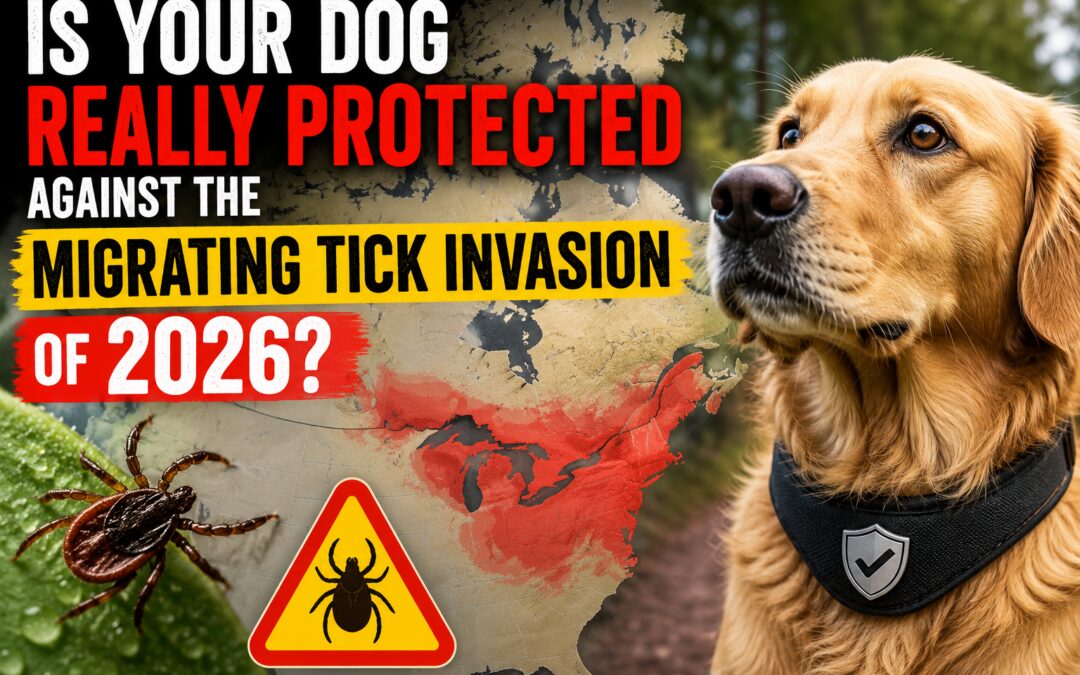
Ticks are no longer a problem limited to a few wooded areas or an occasional spring hike.
Across Canada and the United States, ticks are being found in more places, remaining active for longer periods and exposing dogs to several potentially serious diseases.
For Canadian dog owners, that matters whether your dog spends weekends at the cottage, walks through local conservation areas or joins you on a road trip into different provinces or across the border to the United States.
It also matters when dogs are imported, adopted from another province or state, boarded, camped with or taken to competitions and training events.
Your dog’s tick risk is not determined solely by where you live.
It’s determined by everywhere your dog has been.
And ticks, being inconsiderate little parasites, do not stop at provincial or international borders.
Tick Risk Is Increasing Across Canada
Blacklegged ticks—often called deer ticks—are established in several parts of Canada.
The Public Health Agency of Canada currently identifies established blacklegged tick populations in:
- Southern Manitoba
- Mid-to-southern New Brunswick
- Nova Scotia
- Western, southern and southeastern Ontario
- Southern Quebec
Western blacklegged ticks are found in parts of British Columbia. Ticks may also be discovered outside known risk areas because they can be transported by birds, deer, people and animals.
Canada’s national Lyme disease incidence rate increased from 11.9 reported human cases per 100,000 people in 2023 to 14.1 per 100,000 in 2024. Federal surveillance reports that the national case count has generally trended upward since reporting began in 2009.
Human surveillance data doesn’t tell us exactly how many dogs will become sick. It does, however, show that infected ticks are established in Canadian communities and that exposure is increasing.
Dog owners should also understand that blacklegged ticks can transmit more than Lyme disease. In Canada, they may carry organisms associated with:
- Lyme disease
- Anaplasmosis
- Babesiosis
- Powassan virus
- Borrelia miyamotoi disease
Not all of these affect dogs in the same way, but the list makes one point rather clearly: the tick conversation should not begin and end with Lyme disease.
Ontario Is Not One Uniform Tick Zone
Ontario dog owners often ask whether their particular town is considered a Lyme disease risk area.
That can be useful information, but it can also create a false sense of security.
Established blacklegged tick populations are found throughout much of western, southern and southeastern Ontario. However, a tick may still appear outside a mapped risk area after being carried by wildlife, migratory birds, travelling pets or people.
A low-risk area is not a no-risk area.
Your dog can also leave home.
A weekend at a cottage, a camping trip, a visit to family, a training event or a simple walk through a different conservation area may change the dog’s exposure.
The useful question is not only:
Are there ticks where I live?
It’s also:
Where has my dog been lately?
The Canadian Regions Dog Owners Should Know
Tick populations are not evenly distributed across the country. Risk varies according to climate, habitat, wildlife populations and the species of tick involved.
Ontario and Quebec
Southern Ontario and southern Quebec contain extensive areas where blacklegged ticks are established.
Dogs that spend time around wooded areas, leaf litter, trail edges, long grass and brush may be exposed. Blacklegged ticks may remain active whenever conditions are mild enough, including during warmer periods outside what owners traditionally think of as tick season.
Ontario and Quebec dogs may be exposed to Lyme disease and anaplasmosis, among other infections associated with blacklegged ticks.
Nova Scotia and Atlantic Canada
Nova Scotia has widespread established blacklegged tick populations and has experienced particularly high Lyme disease activity.
New Brunswick also has established populations, especially in its middle and southern areas. Prince Edward Island and Newfoundland and Labrador continue to monitor tick activity and emerging risk.
Anyone travelling through Atlantic Canada with a dog should use appropriate prevention and perform daily checks.
The ocean view may be lovely. The ticks are not there for the scenery.
Manitoba and the Prairies
Blacklegged ticks are established in southern Manitoba. Other tick species, including American dog ticks, may also be encountered in Prairie regions.
Dogs travelling through tall grass, brush, fields or wooded edges can pick up ticks even when they are not in a well-known Lyme hotspot.
British Columbia
British Columbia has western blacklegged ticks rather than the eastern blacklegged tick more commonly discussed in Ontario and the northeastern United States.
Lyme disease risk is generally lower than in many parts of eastern Canada, but it’s not zero. Travel outside the province may also change a dog’s exposure considerably.
Northern Canada
Northern regions have historically had fewer established tick populations because of colder conditions.
However, ticks may still be transported north by birds, wildlife, people and pets. Changing climate conditions may also make some regions more suitable for tick survival over time.
No owner should assume that finding a tick is impossible simply because the dog lives outside a well-known risk zone.
Tick-Infested Areas Across the United States
The United States contains several major tick regions, each with different tick species and disease concerns.
A dog travelling south from Canada may pass through several of these regions during one road trip.
The Centers for Disease Control (CDC) cautions that tick populations can occur outside the shaded areas on surveillance maps. Finding a tick species in a region also does not automatically mean every tick carries disease, but it confirms that exposure is possible.
The Northeastern and Upper Midwestern United States
The northeastern and upper midwestern states are among the best-known areas for blacklegged ticks and Lyme disease.
Higher-risk regions include parts of:
- Maine
- Vermont
- New Hampshire
- Massachusetts
- Connecticut
- Rhode Island
- New York
- Pennsylvania
- New Jersey
- Wisconsin
- Minnesota
- Michigan
Blacklegged ticks are widely distributed throughout the eastern United States. The highest bite risk generally occurs during spring, summer and fall, although adult ticks may search for hosts during winter whenever temperatures rise above freezing.
That last point matters for Canadian owners who still think tick season ends when they put away the lawn furniture.
If the ground is not consistently frozen and temperatures are above freezing, some ticks may still be active. Deep snow provides insulation to protect ticks over the winter.
The Southern and Central United States
Dogs travelling through the South and central states may encounter lone star ticks, American dog ticks and brown dog ticks.
Lone star ticks are widely distributed across the northeastern, southern and midwestern United States, and have recently been identified in parts of Canada. They are aggressive ticks and may be associated with ehrlichiosis and other infections.
American dog ticks are widespread east of the Rocky Mountains and are also found in limited areas farther west. Bite risk is generally highest in spring and summer.
Depending on the region, concerns may include:
- Ehrlichiosis
- Rocky Mountain spotted fever
- Tularemia
- Other spotted-fever infections
This is why the preventive product used successfully at home may need to be reviewed before a lengthy U.S. trip.
The Rocky Mountain and Western Regions
The Rocky Mountain wood tick is found across portions of the western United States, including mountain and foothill regions.
It may transmit organisms associated with Rocky Mountain spotted fever, tularemia and Colorado tick fever in people. Some ticks can also cause tick paralysis through toxins released while feeding.
Despite its name, Rocky Mountain spotted fever is not limited to the Rocky Mountains. The name has probably caused almost as much confusion as the disease itself.
Dogs visiting Colorado, Montana, Wyoming, Idaho or neighbouring regions should be checked carefully after hiking through grass, brush and wooded trail edges.
The Brown Dog Tick Is a Travelling Problem
The brown dog tick deserves special attention because it behaves differently from many outdoor ticks.
It strongly prefers dogs and can establish itself inside:
- Homes
- Kennels
- Garages
- Crates
- Dog runs
- Boarding facilities
- Transport vehicles
- Camper vans and trailers
A brown dog tick can be carried home from a trip and begin reproducing indoors.
That means a tick problem may continue even after the dog has left the trail, campground or warmer climate where exposure occurred.
Repeatedly finding ticks inside your home—or finding them on a dog that has not recently been outdoors—may indicate an infestation. This generally requires veterinary advice and professional pest-control help.
Washing one dog bed and declaring victory may be emotionally satisfying, but the ticks are unlikely to be impressed.
Why Travel History Matters to Your Veterinarian
A dog living in Ontario that recently returned from Pennsylvania, Colorado or Florida has a different exposure history from a dog that has remained close to home.
Likewise, a Colorado dog that spent several weeks in southern Ontario may have been exposed to blacklegged ticks and Lyme disease risk that is less common in Colorado.
When your dog is unwell, tell your veterinarian:
- Every province or state recently visited
- Whether the dog went hiking or camping
- Whether the dog stayed in a kennel
- When the trip occurred
- Whether you found or removed a tick
- What preventive product was used
- When the most recent dose was given
Don’t assume that travel from several weeks earlier is irrelevant.
Symptoms associated with tick-borne illness may not appear immediately, and early signs are often vague.
Signs of Tick-Borne Illness in Dogs
Depending on the disease and stage of infection, possible signs include:
- Fever
- Reduced appetite
- Lethargy
- Stiffness
- Intermittent lameness
- Painful or swollen joints
- Enlarged lymph nodes
- Pale gums
- Bruising
- Unusual bleeding
- Vomiting or diarrhea
- Facial or limb swelling
- Weakness
- Loss of coordination
- Difficulty standing
- Neurological changes
A dog may simply seem quieter, slower or less interested in food.
That’s not enough to diagnose a tick-borne disease, of course. Dogs have an impressive ability to produce the same six symptoms for about forty different medical problems.
It’s enough to justify calling your veterinarian, particularly when there has been known tick exposure or recent travel.
Sudden weakness, difficulty standing, breathing problems or trouble swallowing require urgent veterinary care.
How to Check Your Dog for Ticks
Preventive products reduce risk, but they do not replace a proper physical check.
After walking through grass, wooded areas, brush or leaf litter, examine the dog slowly and systematically.
Pay particular attention to:
- Around and inside the ears
- Around the eyelids and muzzle
- Under the collar
- Beneath the harness
- Under the front legs
- Between the toes
- Around the groin
- Along the belly
- Under the tail
- Around the neck and shoulders
Use your fingertips to feel for tiny bumps.
Small ticks can resemble a seed, scab or skin tag. Long-coated dogs require extra care because ticks can disappear beneath the coat.
Check the dog before getting into the vehicle after a hike and again when you arrive home.
Also inspect your clothing, camping gear, dog bedding and crates. An unattached tick brought inside on the dog may later attach to another pet or person.
How to Remove a Tick Safely
Use fine-tipped tweezers or a proper tick-removal tool.
- Put on gloves.
- Part the dog’s coat so you can see the attachment point.
- Grasp the tick as close to the skin as possible.
- Pull upward using slow, steady pressure.
- Do not twist, jerk or crush the tick.
- Clean the bite area and disinfect the tool.
- Wash your hands thoroughly.
- Save the tick in a sealed container or take a clear photograph if identification may be useful.
Current CDC guidance recommends pulling an attached tick away from the skin with steady, even pressure rather than twisting or jerking it.
Don’t burn it, smother it with petroleum jelly or coat it in essential oils while it is attached.
The goal is prompt removal, not testing every peculiar tick remedy ever suggested on social media.
Should Dogs Use Year-Round Tick Prevention?
The Companion Animal Parasite Council supports consistent tick control because tick-borne disease risk is dynamic, dogs travel, and some ticks remain active during mild winter conditions or live indoors.
CAPC’s 2026 forecasts continue to track changing canine Lyme disease, anaplasmosis and ehrlichiosis risk across the United States, along with Lyme disease risk in southern Canada.
Whether your dog needs year-round protection, seasonal protection or a different product for travel should be discussed with your veterinarian.
The decision should consider:
- Where you live
- Where the dog travels
- Your local temperatures
- The dog’s outdoor activities
- Whether the dog hunts or camps
- Boarding and daycare exposure
- Previous tick findings
- Health history
- Other pets in the home
- The safety and effectiveness of the product
Natural does not automatically mean safer.
Commercial does not automatically mean appropriate for every dog.
The sensible question is: What provides effective protection for this particular dog, given this dog’s health and actual exposure?
Before Crossing the Canada–U.S. Border With Your Dog
Before travelling, ask your veterinarian:
- Which ticks are common at the destination?
- Which diseases occur there?
- Is my dog’s current preventive adequate?
- When should treatment begin?
- Is Lyme vaccination appropriate?
- Should the dog be tested before or after travel?
- What symptoms should I watch for?
- What should I do if I find an attached tick?
Don’t wait until the night before departure.
Some products need to be administered before exposure, and your veterinarian may want time to review your dog’s medical history.
The Bottom Line
Canada has established and expanding tick populations, especially in southern portions of Ontario, Quebec, and Manitoba, and across parts of Atlantic Canada and British Columbia.
The United States contains several heavily infested regions, including the Northeast, upper Midwest, South, central states and portions of the Rocky Mountain and Pacific regions.
Each area may expose dogs to different ticks and different diseases.
That means your dog’s prevention plan should account for more than your home address.
Check the dog after outdoor activity. Use an appropriate preventive product. Keep track of travel. Remove ticks properly. Tell your veterinarian where the dog has been.
You don’t need to avoid every trail, campground or cottage.
You need to stop assuming that ticks only live somewhere else.
 Karen Laws is a certified professional dog trainer, the founder of The Ontario Dog Trainer and the Dog Trainer TRIBE Training Academy. With decades of experience training dogs, educating people, and mentoring aspiring trainers, she is known for her practical, no-nonsense approach to helping both dogs and humans succeed.
Karen’s professional background includes education, public service, wildlife biology, competitive field dog work, and pet dog training. That combination gives her a unique perspective on behaviour, leadership, communication, and what it really takes to create lasting results.
Through her work with dog owners and developing trainers, Karen teaches far more than training exercises. She helps people understand the dog in front of them, improve their communication, and build the kind of confidence that leads to better outcomes in both training and business.
Karen is especially passionate about mentoring pet dog trainers who feel stuck and are ready to grow. Her message is clear, real, and grounded in experience: success in dog training comes from understanding behaviour, building trust, and being willing to do the work.
Follow Karen on Social Media: FaceBook, Instagram, LinkedIn, TikTok, YouTube,
Need personal help? Let’s chat! Click here to book a Virtual assessment!