
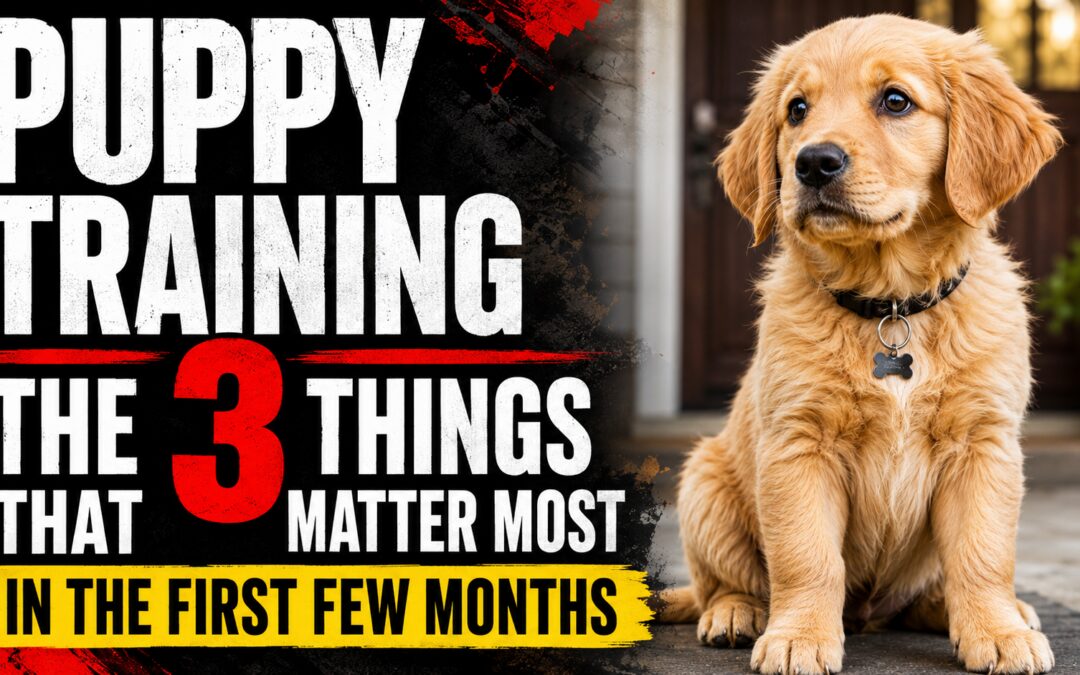
Bringing home a puppy is exciting.
It’s also noisy, messy, exhausting, occasionally ridiculous, and often a very quick reminder that puppies do not arrive with an operating manual.
One minute they’re sleeping peacefully. The next, they’re chewing the table leg, peeing on the floor, hanging off your pant leg, ignoring the toy you bought them, and racing through the house like they’ve just remembered an urgent appointment in another province.
This is normal. But it’s also where puppy training really begins.
The biggest mistake I see is that people become so focused on teaching commands that they miss the bigger picture. A well-trained puppy is not simply a puppy that can sit. What matters far more is whether that puppy learns how to live successfully with you.
After decades of working with dogs, I keep coming back to three things that matter most in early puppy training:
- Building connection and engagement
- Creating structure and good household habits
- Developing confidence in the real world
Get these three things right, and everything else becomes easier.
And if you train dogs for a living, keep reading past the puppy advice. These same three things — connection, structure, confidence — are also the three things missing from most trainers’ businesses. You’ll see what I mean as we go.
1. Build Connection Before You Worry About Perfect Obedience
Most puppy owners want the same thing. They want a puppy that listens. But listening does not begin with commands. It begins with connection.
Your puppy has just left the world they knew. Their littermates are gone. Their routines have changed. Their surroundings are unfamiliar. Then we bring them into our homes and immediately start asking them to understand words they’ve never heard before.
“Sit.” “Come.” “Leave it.” “Off.” “No.” “Drop it.”
Apparently puppies are expected to become bilingual before lunch.
Instead, start with something simpler. Teach your puppy that paying attention to you is worthwhile. That means becoming part of your puppy’s environment rather than simply standing in the background calling their name repeatedly.
Use food. Use play. Use movement. Reward your puppy when they voluntarily check in with you. Call them from short distances, when they have no other option, and make coming to you worthwhile. Hand-feed some meals. Move away and encourage them to follow you. Reward eye contact.
This is the beginning of recall. It’s the beginning of leash walking. It’s the beginning of impulse control. And yes, it’s also the beginning of that elusive thing every owner asks me about: “Why isn’t my dog listening to me?”
Connection comes first. Commands work much better after that.
For the trainer reading this: A new client doesn’t listen to your recommendations any better than an unbonded puppy listens to “sit.” If the first thing they hear from you is a price list or a training plan, you’re skipping straight to commands. Connection with a client looks like understanding their actual problem before you talk about your solution — the 3 a.m. barking, the embarrassment at the dog park, the fear their dog might bite someone. Build that first. A client who feels understood books the package. A client who gets a quote, shops around for a cheaper one.
2. Structure Creates Good Habits
Puppies are excellent at learning. Unfortunately, they are equally good at learning things you never intended to teach.
Jumping works if it gets attention. Stealing socks works if it starts a game of chase. Barking works if someone opens the door. Nipping works if everyone starts waving their hands around and squealing.
Puppies are researchers. They conduct experiments all day long. “If I do this, what happens?”
Your job is to make sure the answers lead somewhere useful.
This is why structure matters. A good puppy routine should include training, play, rest, bathroom breaks, supervised freedom, appropriate chewing, and quiet time.
Too much freedom too soon is one of the most common mistakes I see. A puppy wandering freely through the house is not “learning independence.” They are usually practising behaviours you will spend the next six months trying to stop.
Use crates, pens, gates, leashes and supervision to manage your puppy’s environment.
Management is not a substitute for training. It is part of training. If your puppy cannot rehearse an unwanted behaviour repeatedly, that behaviour is much easier to prevent.
At the same time, deliberately teach the behaviours you do want. Teach calm. Teach waiting. Teach settling. Teach your puppy that sometimes nothing exciting is happening.
For the trainer reading this: Same principle, different puppy. Right now, your business is probably running on whatever happens to walk through the door — texts at 9 p.m., a client who reschedules three times, a rate you quote differently depending on your mood that day. That’s a business with no crate and no gates. It’s not freedom, it’s just unmanaged repetition of the same problems, week after week. Structure — a real intake process, a set price sheet, a contract, boundaries on when and how clients reach you — isn’t the boring part of the business. It is the business. Without it, you’re not running a company. You’re just doing a lot of favours for money.
3. Confidence Matters More Than Exposure
Socialization is one of the most misunderstood parts of puppy training. Many people think it means “let my puppy meet as many dogs and people as possible.” That can actually create problems.
Good socialization is not about quantity. It’s about helping your puppy learn how to behave confidently and calmly around the world.
Your puppy does not need to greet every dog. They don’t need to say hello to every person. They don’t need to attend every chaotic dog park, busy event or crowded pet store.
Sometimes the best socialization is simply watching. Let your puppy observe another dog from a comfortable distance. Walk through a parking lot. Sit outside a coffee shop. Walk across gravel, grass, pavement and wooden surfaces. Hear trucks. Watch bicycles.
The goal is not to create a puppy who thinks “I must interact with everything.” The goal is to create a puppy who thinks “I’ve seen this before. No big deal.”
A confident dog can notice the world without needing to react to everything in it.
For the trainer reading this: This one’s for you specifically. You’ve already done the hard part — you can read a dog before it moves, you’ve handled the cases nobody else wanted, you’ve fixed things in a backyard in twenty minutes that a $3,000 board-and-train couldn’t touch. But if you’re still describing that as “I just kind of have a way with dogs,” you’re the equivalent of a puppy that hasn’t been socialized — plenty of exposure, no confidence to show for it. You don’t need more experience. You need to stop flinching every time a client asks what you charge. Confidence isn’t built by doing more free consults or taking on more “just to build a reputation” jobs. It’s built the same way it’s built in a puppy: by proving to yourself, on purpose, that you can handle the moment without over-reacting to it. In your case, that moment is a client asking “why do you cost more than the trainer at the pet store,” and having an answer that doesn’t shrink.
Puppy Training Is Really About Daily Life
Training sessions matter. But your puppy is learning whether you are formally training or not. They’re learning when you open the door, when you prepare food, when guests arrive, when you clip on the leash, when you laugh because they stole your sock.
That last one may not produce the lesson you intended.
Training time is all the time. Every interaction teaches your puppy something. The question is simply whether you are teaching deliberately or accidentally.
The same is true of your business, if you’re the one reading this as a trainer. Every client interaction, every quote, every “oh, I just have a way with dogs” at a party — it’s all teaching the market who you are. The question is whether you’re teaching it on purpose.
Don’t Chase Perfection
Your puppy doesn’t need to know twenty commands by twelve weeks old. They don’t need a perfect heel or a flawless stay. They’re babies.
What they need is a foundation: engagement, structure, confidence, and someone willing to prevent bad habits before they take hold rather than fix them after.
Progress won’t always happen in a straight line. Some days your puppy will look brilliant. The next day they will appear to have forgotten everything, including their own name.
Welcome to puppy training.
Want the step-by-step version of everything above? The Art of Puppy Parenting is just $97 for lifetime access
For Trainers: You Already Have the Skill. Let’s Build the Business Around It.
If you got this far and the “for the trainer” notes hit closer to home than the puppy advice, that’s not an accident.
You didn’t learn what you know from a weekend seminar. You learned it from doing it, over and over, until it became instinct. The gap isn’t your skill. It’s that you’re running a five-star operation with no sign, no menu, and no prices on the board — and people are starting to notice you deserve better than that, even if you haven’t said it out loud yet.
The Dog Trainer TRIBE Academy is where that gets fixed. It’s coaching built specifically for trainers who already have the hands-on ability and need the business, pricing and positioning to finally match it — starting with TRIBE Foundations at $697
If you’ve been doing the work without the recognition, this is where that gap closes.
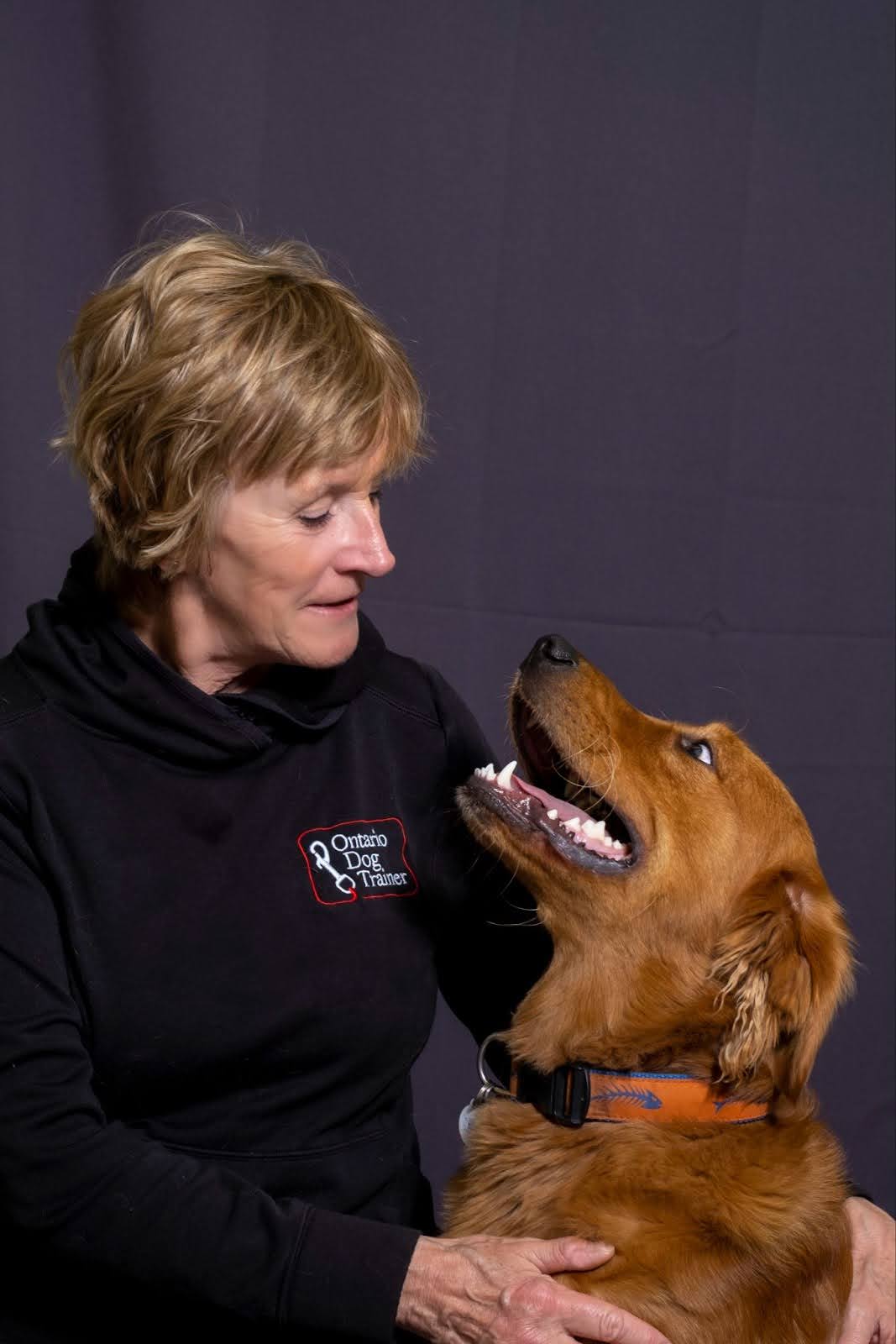 Karen Laws is a certified professional dog trainer, the founder of The Ontario Dog Trainer and the Dog Trainer TRIBE Training Academy. With decades of experience training dogs, educating people, and mentoring aspiring trainers, she is known for her practical, no-nonsense approach to helping both dogs and humans succeed.
Karen’s professional background includes education, public service, wildlife biology, competitive field dog work, and pet dog training. That combination gives her a unique perspective on behaviour, leadership, communication, and what it really takes to create lasting results.
Through her work with dog owners and developing trainers, Karen teaches far more than training exercises. She helps people understand the dog in front of them, improve their communication, and build the kind of confidence that leads to better outcomes in both training and business.
Karen is especially passionate about mentoring pet dog trainers who feel stuck and are ready to grow. Her message is clear, real, and grounded in experience: success in dog training comes from understanding behaviour, building trust, and being willing to do the work.
Follow Karen on Social Media: FaceBook, Instagram, LinkedIn, TikTok, YouTube,
Need personal help? Let’s chat! Click here to book a Virtual assessment!