By the time I decided to leave the competition world and start training pet dogs, I’d spent nearly twenty years training my own Labrador Retrievers, earned numerous Field Trial Championship titles, and travelled extensively to compete and learn from some of the best people in the sport.
I knew I could train dogs. I was good at it.
And I still wasn’t convinced I had enough knowledge, experience, or skill to call myself a professional dog trainer.
Sound familiar?
Yet I kept looking for the next piece of information. The next workshop. The next answer. Surely there was something else I needed to learn before I could say, “I’m a professional dog trainer.”
There usually was something else to learn, of course. There always is. That’s one of the hazards of working with dogs: the minute you think you know everything, a dog will arrive and politely, or not so politely, inform you otherwise.
But eventually, I learned that more information wasn’t actually the thing holding me back.
Thought I Needed More Education
Like many people who are serious about getting good at something, my solution was predictable: learn more. So I sought out more education and attended another workshop.
That workshop happened to be taught by Martin Deeley, who became an important mentor of mine. Martin was from the U.K. and knew quite a bit about my background, since we’d trained and competed with gun dogs during the same time period, in different countries.
Over dinner one evening, I admitted something to him. Despite everything I’d done with dogs, I still didn’t really see myself as a professional dog trainer. I didn’t think I was ready.
He stopped me.
“You know more than you think you know.”
Then he named what I hadn’t been able to see myself: I wasn’t afraid of the dog-training part. I was afraid of the business part.
Well. There it was. Not terribly complicated, once somebody actually said it out loud.
Sometimes You Don’t Need Another Workshop
That conversation gave me an important realization. I’d spent a lot of time assuming my hesitation meant I needed more dog-training knowledge. It didn’t.
My problem wasn’t that I couldn’t train dogs. My problem was that I didn’t yet know how to take what I knew and turn it into a professional service for other people. Those are two very different skills, and I see aspiring trainers confusing them all the time.
They’ve trained their own dogs. They’ve studied behaviour. They’ve attended seminars and worked with different breeds. Some have competed in dog sports, volunteered with rescues, worked in kennels, shadowed trainers, or already helped friends and family with their dogs.
Ask them whether they know anything about dog training, and they’ll tell you about years of experience. Ask, “Are you a professional dog trainer?” Suddenly things get a little quieter.
Martin’s Advice Was Pretty Simple: Just. Start.
Martin’s advice wasn’t to sign up for another dozen workshops. He told me to get started.
So I did something remarkably sophisticated. I made business cards.
Yes. That was essentially the grand beginning. No elaborate funnel, no massive social media following, no perfectly polished brand strategy. Business cards.
I started talking to people about what I was doing. The very next week, I was at my veterinarian’s office for a routine checkup and mentioned I was thinking about training pet dogs as a business. He stopped the exam mid-sentence.
“Oh my God, give me your cards. People NEED what you can provide right now.”
Clients started coming. And then I began doing what ultimately taught me more than another stack of notebooks ever could: I worked with real dogs and real owners.
Education Didn’t Stop. It Just Changed Shape.
Once I started working professionally, my learning changed. I could take what I knew and test it, see what worked, and identify what didn’t. I learned how to explain training to owners, and how to adapt when my first explanation didn’t land.
I developed techniques, then refined them. I developed processes, then refined those. Eventually, I built a professional training system I could reproduce and teach to other people, and I’m still refining it.
That’s what professionals do. You don’t arrive at some magical moment when you suddenly know everything. You develop competence through education, experience, application, feedback, and refinement.
Knowledge Is Not the Same as Professional Confidence
Today I talk to aspiring trainers who’ve spent years learning about dogs and still don’t feel confident calling themselves professional dog trainers. I recognize that feeling immediately. I’ve been there.
Sometimes the next step really is more education, since there may be real gaps in your knowledge or practical skills. But sometimes the next step isn’t another workshop, another webinar, or another 47 saved Instagram posts you’re definitely going to organize someday.
Sometimes you already know considerably more than you give yourself credit for. What you need is help integrating what you know and turning it into practice:
- How to assess the dog in front of you
- How to develop a training plan
- How to coach the owner
- How to communicate professionally
- How to handle the question you didn’t expect
- How to build systems so you’re not reinventing your business with every client
- How to market your knowledge, skills and abilities so people can find and hire you
And perhaps most importantly, you need experience with someone knowledgeable enough to help you recognize what you’re doing well, and where you still need work.
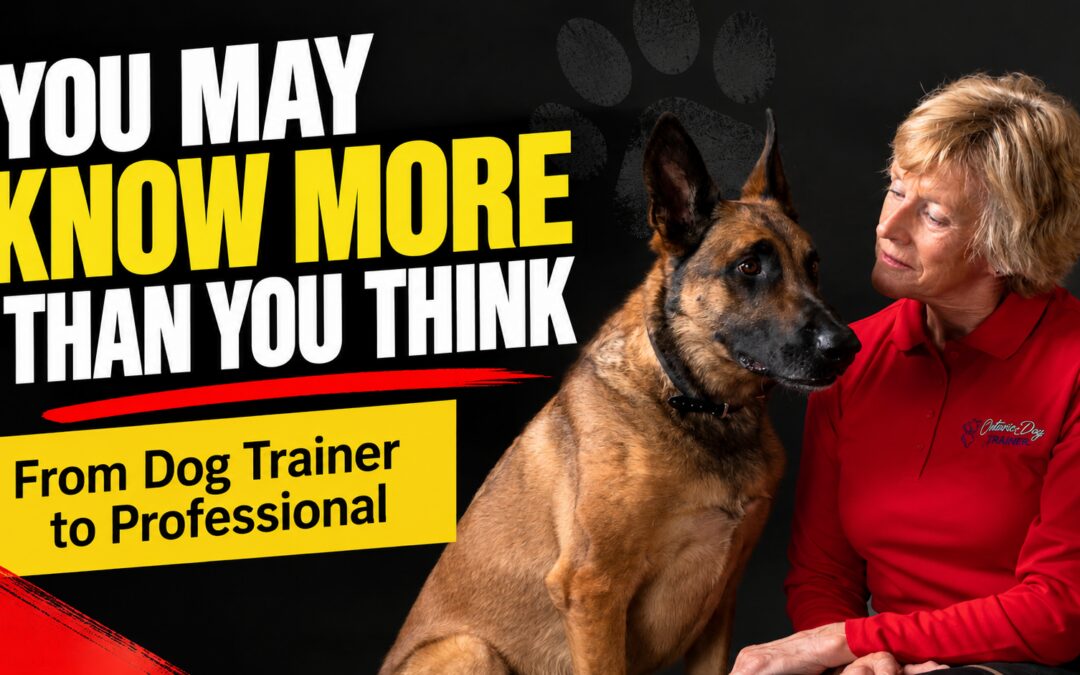
From Dog Trainer to Professional
There’s an important distinction between knowing how to train dogs and knowing how to work successfully as a professional dog trainer. Professional development requires both, and that’s the heart of what I cover in my masterclass, From Dog Trainer to Professional.
We’ll look at what it really takes to move beyond simply accumulating dog-training knowledge, and start developing the practical, professional, and business skills required to work confidently with dogs and their people.
Because if you’re waiting for the day you wake up and suddenly feel like you know everything, you may be waiting a while. Dogs are particularly good at preventing that.
Ready to Take the Next Step?
If you’ve been studying dog training, working with dogs, attending workshops, and quietly wondering, “Do I actually know enough to do this professionally?”, this masterclass is for you.
Come join me for From Dog Trainer to Professional, where I’ll walk you through the same client journey I use with every real client today, from that first inquiry through to a plan the owner can actually follow. You’ll leave with a framework you can use with your very next client, not just another folder of notes.
And remember the advice that changed the direction of my career: you may know more than you think you know. The next step is learning what to do with it.