
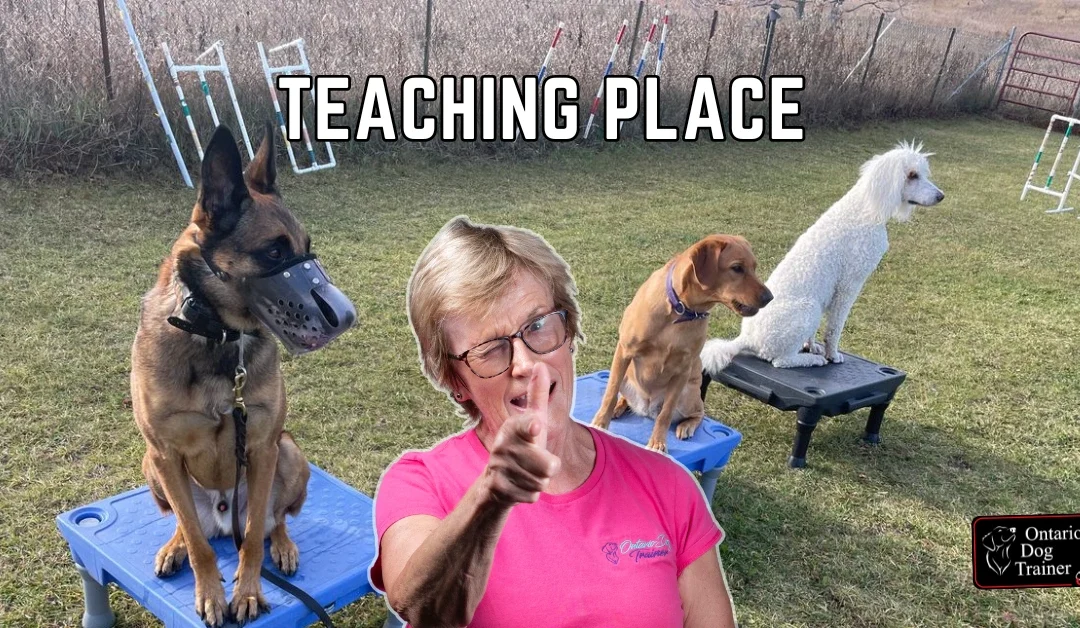
Are You Actually Teaching “Place” — Or Just Hoping Your Dog Stays Put?
Karen here. Let me ask you something straight up: when you tell your dog to go to their “place,” do they go there, stay there, and know what that even means? Or is it more of a hopeful suggestion that you toss out when company arrives and chaos is circling the snacks?
The Place Command isn’t just a party trick or a cute routine. It’s one of the most practical, sanity-saving tools you can teach your a dog. Used properly, it helps manage excitement, supports calm behavior, builds structure, and gives your dog clarity about what to do in all kinds of busy or boring situations.
This article breaks it down clearly and calmly—the way I teach it to my own dogs and clients. No fluff, no gimmicks, and definitely no baby talk.
Let’s get into it.
What Is the Place Command?
A Stay with Purpose
The Place Command means your dog goes to a designated spot—a mat, raised cot, blanket, or pallet—and stays there until you release them. It’s a structured version of “stay,” but with more clarity and less nagging. Think of “place” like a crate without walls.
Dogs learn to self-regulate, settle their excitement, and build independence. You can use this at home, in the shop, during client sessions, or anywhere you want to park the dog mentally and physically.
Why Dogs Benefit From Place Training
- Creates calm: Helps dogs de-escalate their energy.
- Builds impulse control: Teaches the dog how to wait and settle without constant reminders.
- Gives owners a break: Sometimes you just need your dog out of the way but not crated.
- Generalizes easily: You can teach your dog that “place” means any defined area, not just one object.
This isn’t just obedience. This is life training
📺 Watch This in Action: Teaching the Place Command | Step-by-Step Dog Training Guide
Step-by-Step: How to Teach the Place Command
Step 1: Introduce the Surface
Start simple. Lead your dog to the chosen surface. Don’t label it yet. Just help them explore and feel safe on it.
Use a leash to guide them. If they’re sniffing around, that’s great. Let them investigate the space first. Comfort with the surface matters before any commands are layered in.
“The idea is to build comfort with the surface. If they’re choosing to stay, let them. That’s a win.”
Step 2: Use Food to Create Momentum
Toss a treat on the mat or cot. When the dog steps on it, immediately mark/reinforce: “YES!” “Good!”
Don’t say “place” yet. Save the label until the dog is offering the behavior reliably. Right now, you’re just helping them make positive associations.
Step 3: Get On, Get Off, Repeat
Some dogs get on easily but don’t want to stay. Others love staying but are unsure about jumping on. That’s okay. The goal here is to build a rhythm:
- Help them on.
- Treat immediately.
- Ask for a short stay.
- Release with a recall or walk-off.
Don’t just say “free” to release. Give them another job, like coming to you and then sitting in front. Structure in, structure out. “If she wants to stay, fine. But if we’re ending the exercise, she should move with purpose.”
Step 4: Add the Word “Place”
Once your dog is confidently getting on and off, start pairing the word “Place” with the action.
Example: As the dog is moving toward the cot, say, “Place! Good place!”
Keep your tone calm and matter-of-fact. No jazz hands needed.
Step 5: Begin Distance and Duration
Now comes the seasoning. Step a foot or two away. Pause. Return and reward. Step to the side. Pause. Reward. The dog learns that staying put is the job, even if you move around.
If they break position, calmly guide them back with the leash. No harsh corrections; no additional food reward. Just clarity.
Add duration gradually. Two seconds, then five, then ten. We’re not raising a statue—we’re building muscle memory.
Step 6: Add Movement and Distraction
Walk past. Drop a treat nearby (but not on the “Place” ). Go to the fridge. The dog needs to learn that the world can move while they stay put.
Always return with a reward for staying.
You want the message to your dog to be – “Even if I walk away, this is still the best place for you to be.
Step 7: Generalize the Skill
Once the dog understands the Place Command on one surface in one room, it’s time to make it useful.
- Move the mat to different areas of the house.
- Practice outdoors or in the shop.
- Try it on different textures: a towel, a piece of plywood, even a rock.
Eventually, you can just say “Place” and the dog will anchor themselves to any defined area. That’s the magic of generalization.
What to Do When Your Dog Doesn’t Want to Comply
Be Patient, Not Passive
Some dogs balk at the idea of staying put. They’d rather pace, bark, or chase the cat.
If that happens:
- Break the exercise into smaller pieces.
- Lower the pressure.
- Go back to the leash.
This isn’t about domination. It’s about leadership. Stay calm, stay clear, and persist with kindness.
Teach the Back End
Dogs who only get their front feet on but leave their back feet dangling? That’s a back-end awareness issue.
Help them up gently. Mark and reward when all four feet are on. Do this until the full-body behavior becomes automatic.
Real Life Uses for the Place Command
When Guests Come Over
“Place” keeps your dog from bowling over Grandma or licking your neighbor’s toddler in the ear.
During Meals
No more hovering, begging, or snatching food off the table.
When You’re on a Call
Send the dog to places and keep your sanity intact.
At the Shop or Office
If your dog hangs out while you work, the Place Command gives them direction so they don’t wander or get into things.
Common Pitfalls to Avoid
Over-Commanding
Once your dog is on place, don’t nag. They aren’t a malfunctioning robot. Let them settle without constant reminders.
Rushing the Process
Place isn’t taught in one afternoon. Some dogs take days or even weeks to fully anchor the behavior. That’s normal.
Using It as a Punishment
Place should feel like a safe job, not a time-out. If you only send your dog there when they’re in trouble, they’ll resist the command.
Final Reminders for Teaching the Place Command
- Use a leash early on to guide and reinforce.
- Start in a quiet environment.
- Keep your sessions short and successful.
- Gradually add distance, duration, and distraction.
- Label only when the dog is clearly doing the behavior.
- Reward calmness, not just compliance.
- Teach the exit—don’t just say “free,” give them a job like a recall.
“Begin with the end in mind and work in baby steps. Baby steps lead to big wins.”
The Place Command isn’t just about having a well-behaved dog. It’s about building leadership, trust, and clarity in your daily life together.
Whether you’re trying to keep your sanity during dinner or just want a calmer dog who can regulate their own behavior, teaching Place is one of the most valuable skills in your toolbox.
And remember: training time is all the time. Stay calm. Be clear. And keep showing up.
If this was helpful, check out the video linked to this blog, and if you’re stuck? I’m just a click away.