
What if I told you the #1 reason your dog is misbehaving isn’t because they’re stubborn, dominant, or broken—it’s because their daily routine is out of whack?
It’s easy to think a tired dog is a good dog. Or that giving them endless affection will calm them down. But here’s what I see over and over in my work with clients:
The right daily structure changes everything.
Especially when it comes to building calm, focus, and trust.
Let’s talk about one of my recent dog students—Percy—a sweet, confused dog labelled as “aggressive” when what he really needed was a predictable outlet for his energy. Iin other words, a predictable, balanced daily activity routine to exercise his brain and his body. Before we dive into Percy’s story, here’s what we’ll cover in this post:
What You’ll Learn:
- What a healthy dog routine actually looks like (hint: it’s not just play)
- How to identify when your dog’s routine is off
- Why your dog needs undisturbed rest (what is ‘undisturbed,’ and how to make it happen)
- The difference between productive work and overstimulation
- Why play isn’t just fun—it’s functional
Let’s get into it.
Meet Percy: Misunderstood and Overstimulated
When Percy first arrived, I was told to expect a “problem dog.” Aggressive. Out of control. Likely needing serious management.
That’s not what walked through the door.
What I met was a soft-eyed, eager pup who had no idea who to trust, how to behave, or when to settle. Percy wasn’t trying to be difficult—he was trying to survive in a household that was all emotion, no structure.
His humans meant well. They loved him. But they were unknowingly feeding the problem:
- Too much (read constant) touch
- Too much talk
- Too much freedom
- And absolutely zero rest
Percy was on high alert 24/7. And when dogs are always “on,” bad habits grow fast.
The Dog Routine That Changed Everything
Living a ‘dog daily routine’ doesn’t have to be difficult or disruptive. It means giving your dog a predictable daily structure and routine they can count on every day. Structure is what happens during each day, and routine is how it happens. Following a predictable daily routine with your dog builds focus on, and trust with you.
There’s a good chance that your dog is the same as Percy – he didn’t need to be ‘fixed,’ he needed clarity.
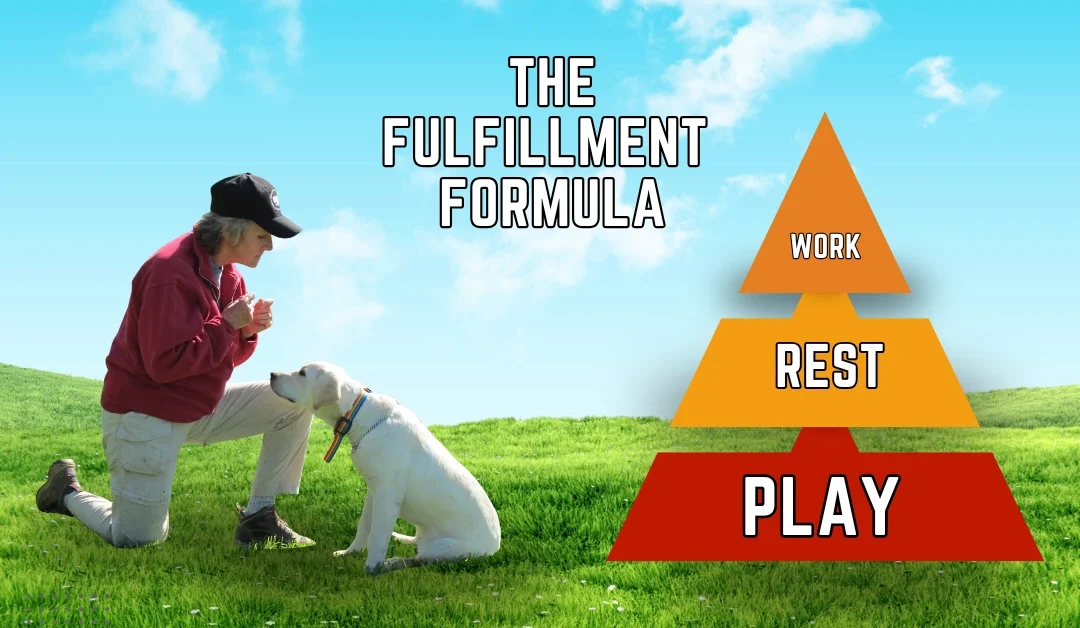
His owner needed to discover how to give him clarity through a consistent dog routine built on three pillars:
✅ Work
✅ Rest
✅ Play
These pillars known as the Fulfillment Formula, apply to every dog, regardless of age, breed, or personality.
What does this formula really mean for you and your dog?
Work: Give Your Dog a Job
“Work” doesn’t mean running an agility course or drilling sit-stay for 30 minutes straight.
What Counts as Work?
- Leash walking with purpose (no sniff-a-thon chaos)
- Waiting at thresholds (doors, crates, stairs) for your permission to move forward
- Coming when called (recall = connection)
- “Go to place” (means your dog goes to, and stays on an area designated by you, until given permission to move to another area, like greet your guests).
- Moving through your dog’s space (teaches your dog to step aside to give you space to pass. Dogs yield in a non-confrontational way when they trust the body moving toward or into their space).
These aren’t just obedience exercises. They’re jobs. And dogs, especially ones like Percy, love to work at their daily ‘jobs’.
When Percy started his structured walks, he stopped dragging people at the end of the leash. When he learned to wait at the door, his mindset shifted from “charge ahead” to “what now, boss?”
By giving Percy short bursts of work—spread throughout the day—he gained mental clarity and confidence. This ‘work’ was not punishment, but was a way for Percy’s owner to talk to Percy in a language they could both speak -: Here’s your role. I’ve got the rest.
By doing these simple, repetitive jobs with your dog every day, you and your dog will build a dictionary of common language – often without you saying a word!
Rest: The Most Underrated Part of a Dog Routine
This one surprises people.
Most dog owners think they’re giving their dog plenty of downtime. But here’s the catch—dogs need undisturbed rest. Not lying on the floor while the kids race around. Not flopped on the couch while the vacuum runs.
Percy’s owners loved having him around all the time. He followed them everywhere, got attention constantly, and was rarely alone.
They meant well.
But Percy was exhausted.
Signs Your Dog Needs More Rest:
- Hyperactivity in the evening
- Barking out of nowhere
- Biting during affection
- Difficulty settling
- Increased reactivity
Sound familiar?
Dogs—especially young ones, up to six months of age—need 16–20 hours of actual sleep per day. That doesn’t happen in a living room with people talking and moving constantly.
How to Give Your Dog Real Rest:
- Use a crate, gated room, or pen for uninterrupted nap time
- Avoid touching or talking to them when they’re resting (Follow this rule: Let sleeping dogs lie! Too many family members get bit by surprising them with touch when it is sleeping soundly)
- Set a predictable nap schedule
- Don’t feel guilty—this is self-care for dogs. Your dog will love you for leaving them alone to sleep peacefully.
Once Percy started getting scheduled, protected rest in his private space crate, everything improved. He was calmer. More focused. Less mouthy.
Sometimes the most powerful part of a dog routine is learning to do nothing.
Play: Where Leadership Meets Fun
Let’s be clear: dogs need play. But not the kind that ramps them up and leaves them wild.
Play with your dog should include:
- Engagement
- Rules
- Leadership
For Percy, that meant tug. Your dog may prefer fetch, hide and seek or other activities where the two of you interact together.
Play with your dog shouldn’t be wild, growly, or frantic tug. The best play is structured tug, with a beginning and an end, and a human who’s clearly in charge.
Rules for Healthy Play:
- You start the game
- You end the game
- No jumping or grabbing at hands
- Use a consistent cue (e.g., “take it,” “out”)
Dogs like Percy, who love control, benefit enormously from structured games. Tug gave him a chance to win within rules—and learn that his human was still the leader, as well as his best friend.
Now, instead of biting in frustration, Percy tugs with joy. Because his family gave him a way to express himself that didn’t lead to confusion or conflict. All dogs, including yours just want to get through each day without conflict. A predictable daily routine will go a long way to creating a happy dog in your home.
Why the Right Dog Routine Creates Calm
Here’s what happened when Percy’s family implemented the Work-Rest-Play formula with Percy:
- The biting stopped because he was no longer overstimulated.
- The pacing and whining stopped because his energy had a purpose.
- The reactivity faded because he finally had someone else managing the room.
In other words… the chaos disappeared.
His humans finally got the sweet dog they always believed was in there. Not because the “bad” was trained out of him—but because he was living within a predictable structure and routine he could trust.
Common Mistakes That Sabotage Your Dog’s Routine
Let’s pause and look at where most dog owners (with the best of intentions) go wrong:
❌ Too much affection, not enough boundaries
Your dog isn’t emotionally equipped to lead. Constant touch creates overstimulation—not connection.
❌ Talking too much
Verbal clutter confuses dogs. Dogs are not verbal creatures (news flash – most humans are way too chatty). Clarity comes from calm body language and consistent cues that encourage your dog to look at you for guidance on what comes next.
❌ Letting play run the day
Play without structure reinforces chaos. Your leadership disappears when the dog calls the shots.
❌ No rest
A tired dog isn’t always a calm dog. An overstimulated, sleep-deprived dog is a ticking time bomb.
Want to Work-Rest-Play Explained?
You’ll also find my video, The Fulfillment Formula, to help you map out your own dog’s work-rest-play plan.
👉 Subscribe to the channel for new weekly videos.
Your Dog Routine Blueprint: A Sample Day
Here’s a basic daily structure to help your dog thrive:
| Time of Day | Activity |
| 7:00 AM | Leash walk (work) |
| 8:00 AM | Breakfast in crate |
| 9:00 AM – 12:00 PM | Rest (crate) |
| 12:30 PM | Obedience reps (5–10 mins) |
| 1:00 PM – 3:00 PM | Rest |
| 3:30 PM | Tug + leash walk |
| 5:00 PM | Dinner + calm hangout |
| 7:00 PM | Structured play or puzzle toy |
| 8:00 PM | Final bathroom break |
| 9:00 PM | Crate for the night |
Adapt this for your lifestyle, but the key principles stay the same:
- Short bursts of structured work
- Dedicated rest windows
- Leadership-based play
The Bottom Line: Dogs Crave Structure
Percy didn’t need to be “fixed.”
He needed clarity. He needed someone to say: “I’ve got this—you can relax.”
When dogs know their role, and their routine stays consistent, everything gets easier:
- Fewer behavioral issues
- Easier vet visits and grooming
- Better house manners
- Deeper trust
The dog routine you choose sets the tone for everything else.
Need Help Building Your Dog’s Routine?
Sometimes it’s hard to see your own routine gaps. That’s where I come in.
If you’re stuck on where to start or your dog is showing signs of frustration, let’s talk. I offer private training, virtual coaching, and video review support.
📩 Message me directly on Instagram. I’ll help you find you and your dog a plan—no judgment, just clarity.
Enjoyed this read? For more no-nonsense insights on dog training and behavior, check out my earlier blogs:
- Tick-Borne Diseases in Dogs: What Every Dog Owner Needs to Know
- Teaching Your Reactive Dog to Stay Calm: The Art of Doing Nothing
- Dog Dental Care: Why It’s More Important Than You Think
Let’s stay connected: