
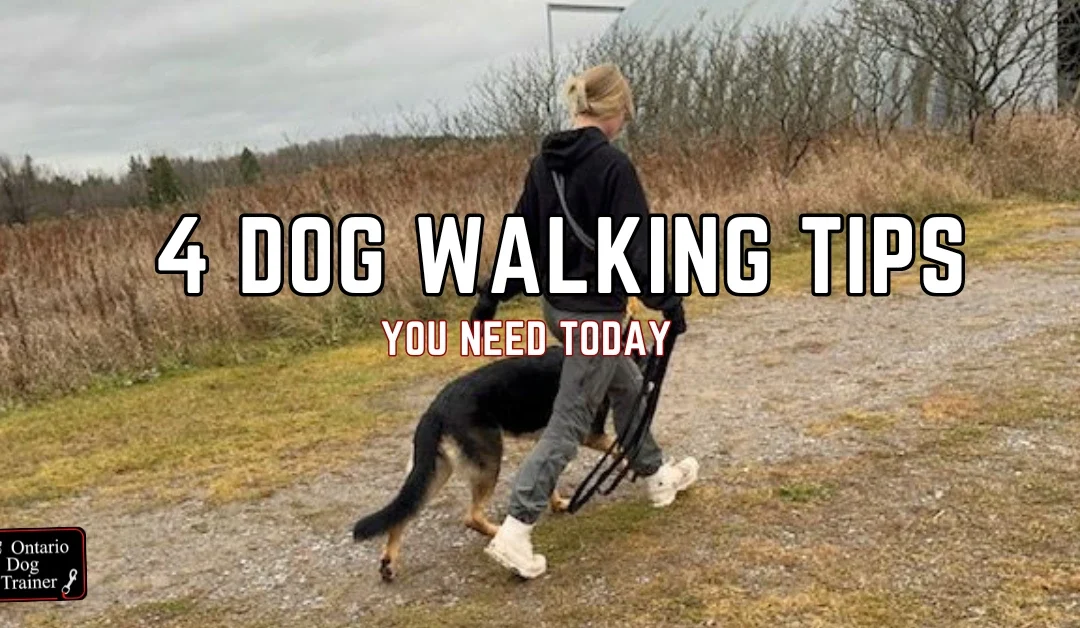
Have you ever stepped outside with your dog and thought, “Here we go again?” The pulling, the barking, the lunging at every squirrel or dog that crosses your path—it can feel like more of a battle than a bonding time.
You are not alone. Many owners struggle with leash reactivity and pulling, and many dogs don’t naturally know how to walk calmly. The good news is that with the right approach, calm and enjoyable walks are possible.
In this blog, I’ll share my best dog walking tips so you can turn leash stress into leash harmony.
Here’s what we’ll cover today:
- The right gear for easier walks
- How to build leash manners at home first
- Using the leash as communication, not control
- Focus games that keep your dog’s attention on you
- Managing reactivity before it escalates
- Fixes for common problems like pulling and barking
1. Start with the Right Foundation
Before you even touch the front door, you can set yourself and your dog up for success.
Choose the Right Gear
The leash is not just a rope that keeps your dog close. It’s a communication tool. Choosing the right equipment from the start gives you control without creating tension.
- Collars: Flat collars are fine for ID tags, but don’t prevent pulling. When your dog pulls, a flat collar can cause more harm than most people realize. A martingale collar is my go-to for many dogs because it gives gentle control without choking.
- Harnesses: A front-clip harness helps redirect dogs that pull. A back-clip harness is fine for calm walkers. Neither harness won’t stop pulling and may actually aggravate the problem.
- Leashes: A well-made, 6-foot biothane or leather leash that feels soft and comfortable in your hand is the best choice. Avoid retractable leashes for walking because the constant tension may encourage pulling, and the bulky handle reduces control and can be dangerous if it slips out of your hand.
👉 Dog walking tip: Good gear makes your job easier, but it’s not just the tool that trains your dog for you. Training success is up to YOU. Your dog is counting on you to do the real work.
Leash Manners Start Indoors
Don’t wait until you’re surrounded by distractions to introduce the leash to your dog. Start indoors or in your yard.
-
- Let your dog sniff the leash and collar before putting them on.
- Initially, use treats and praise to reward calm behavior when you first put the collar on and attach the leash. Practice inside without distractions,
- Holding the leash loosely and beginning with the foot closest to the dog, take one step forward at a time.
- Mark with “yes” and reward every time your dog chooses to stay close to you and the leash stays slack.
- Repeat until your dog is waiting for your foot movement before they move.
-
- When your dog is focused on you, add another step and repeat the process, taking two steps at a time, then three, four and soon, adding another step each time your dog chooses to stay beside you, and the leash remains loose.
- When your dog is focused on you, add another step and repeat the process, taking two steps at a time, then three, four and soon, adding another step each time your dog chooses to stay beside you, and the leash remains loose.
This simple practice builds positive associations so the leash means “time with you” instead of “tension and stress.”
2. Communicate Through the Leash
Think of the leash as a quiet conversation. If you’re always pulling or holding tension, your dog hears stress. If you use a system of adding and releasing leash tension, your dog hears guidance.
- Pressure and release: Apply light pressure to the leash to “ask” for your dog to move closer to you, or with you. The second your dog responds by leaning, or moving toward you, release the tension and praise.
- Hands and posture: Keep your hands soft, elbows against your side and shoulders relaxed. Let the leash drape over your hand with a little smile between you and where it is clipped to your dog’s collar.
- Calm presence: Walk with confidence, steady breathing and focused forward. Your dog mirrors your energy.
👉 Dog walking tip: A loose leash isn’t just about mechanics; it tells your dog, “We’re calm, we’re safe, we’re moving together.”
3. Build Focus Before You Face the World
A distracted dog is potentially a reactive dog. If your dog learns to check in with you, it is their way to show they trust you to keep them safe. Their ‘check in’ gives you the time to respond and move safely together when things get tough.
Name Game
Say your dog’s name once. When they look at you, immediately mark it with “yes” and reward. Practice indoors, then outside, then around distractions.
Watch Me
Hold a treat near your eyes and say “watch.” Reward eye contact immediately. Slowly increase duration, then use it on walks when distractions appear.
👉 Why this works: Focus gives your dog a job, and it makes you more rewarding than the environment.
4. Managing Reactivity with Thresholds
Reactivity doesn’t come out of nowhere. Dogs show signals before they explode—staring, stiffening, holding their breath, or raising hackles. That’s called reaching threshold.
The trick is to work below threshold:
- Find the distance where your dog can notice the distraction that may trigger their reaction, but still stay calm.
- Reward calm behavior at that distance.
- Slowly decrease the distance over time as your dog stays relaxed.
👉 Dog walking tip: When in doubt, add space and keep moving. Movement away from a distraction is more than avoidance, it’s smart training that earns your dog’s trust.
Fixing Common Problems
Pulling
Use the stop-and-go rule: If the leash tightens, you stop. When your dog softens the line or comes back, you resume moving forward. Dogs learn fast that a loose leash makes the walk go on.
Barking
Use your “watch me” cue or move to add space and/or place your body between your dog and the focus of their attention. Reward quiet glances at you.
Distraction
Practice in quiet areas first, then gradually add busier environments. Layer distractions over time instead of diving straight into chaos.
Learn Inside The Great Stroll
You don’t have to figure this out on your own. In my online leash training course, The Great Stroll, I walk you through each of these steps with clear video lessons. You’ll see exactly how I handle pulling, barking, and those tough pass-by moments with other dogs. If you’re serious about transforming your walks, this program gives you the full plan.
Whole-Dog Habits That Make Walks Easier
Leash training is not just about the leash. Lifestyle plays a big role in how your dog behaves on walks.
- Exercise: A dog with energy to burn will pull more. Match your dog’s breed and age with the right mix of walks, play, and training to fulfill their daily needs.
- Mental enrichment: Puzzle feeders, sniff games (indoors and outside), and short training drills at home calm the brain as much as long walks calm the body.
- Handler influence: Your energy matters. Dogs read us. Stay calm, consistent, and patient. Consistency builds trust, and trust makes learning easier.
Calm, connected walks are possible.
The key is not to expect perfection overnight. Build small wins, like a calm start at the door, ten steps of a loose leash, and one quiet pass-by. Stack those wins and you’ll see real change.
Here’s a quick recap of the dog walking tips that work:
- Use training gear that supports learning, not shortcuts.
- Start leash manners indoors before facing distractions.
- Communicate by adding and releasing tension, not constant pulling. Remember: it takes two to pull.
- Teach focus with simple games like the Name Game and Watch Me.
- Work under your dog’s threshold of tolerance to prevent reactivity.
- Use stop-and-go and reward zones to fix pulling.
- Support your dog’s whole lifestyle with exercise, enrichment, and consistency.
👉 Don’t risk harming your bond with your dog by trying to navigate the leash walking journey alone. Get a clear, proven roadmap for transforming your walks by joining my online leash course The Great Stroll. You’ll learn the same techniques I use with my own dogs and with clients, so you can enjoy the kind of calm, connected walks you’ve been hoping for.
Every leash walk is a chance to build trust, confidence, and connection with your dog. Start with one of these tips today, and let your next stroll be the best part of the day for you, and for your dog!.