
Have you ever opened the front door and watched your dog bolt out before you could even blink?
Maybe it’s when a friend drops by, or when you’re grabbing a delivery from the porch. You think your dog will wait — but instead, you’re chasing them down the driveway while your heart pounds in your chest.
If that sounds familiar, you’re not alone. “Door dashing” is one of the most common and dangerous habits dogs develop, and it often starts with excitement and ends with a safety risk. The good news? You can fix it.
In this article, we’ll cover:
- Why doorways trigger chaos and disobedience
- The real reason dogs dash through open doors
- How to start teaching Safety at the Door with structure and calm
- Step-by-step door training routines you can do every day
- What to do if your dog already rushes or ignores commands at the door
Why Safety at the Door Matters More Than You Think
Most owners don’t think of door manners as a safety skill — but it is.
Every year, countless dogs are lost, injured, or killed after running out an open door. The danger isn’t just traffic. A dog that bolts can get into fights, chase wildlife, or vanish into unfamiliar territory.
The door is also the one place where your dog’s instincts, energy, and leadership testing all collide.
It’s exciting. It’s full of new smells, sounds, and distractions. And if you haven’t built rules around that space, your dog sees it as their decision point — not yours.
Safety at the Door is about control, calm, and clarity. It teaches your dog that waiting at a boundary is part of the job, not optional obedience. And it teaches you how to lead with intention instead of reaction.
Why Dogs Dash Through Doors
Before we fix the behavior, we need to understand it. Door dashing isn’t rebellion — it’s instinct, confusion, or a lack of structure.
1. Instinct and Curiosity
Dogs are explorers. The door is a portal to adventure. A small crack in the door is an open invitation for a curious mind.
2. Lack of Boundaries
If your dog has never learned that doorways require permission, they’ll assume freedom the moment it opens.
3. Human Habits
Many owners unintentionally reward the behavior. Talking to the dog, chasing them when they bolt, or repeating “stay” in a rising voice all add energy to the moment.
4. Inconsistency
Sometimes the dog is invited out, sometimes not. Without a clear rule, the dog doesn’t know what to expect — so they make their own choices.
Once you see the pattern, it’s easier to fix it.
How to Teach Safety at the Door: Calm Comes First
If you only remember one rule, it’s this: The door is never a free-for-all.
Teaching Safety at the Door isn’t about yelling “stay!” louder or grabbing for the collar at the last second. It’s about slowing everything down and creating a pattern of calm repetition.
Start by choosing one door — your front door, garage door, or even a back door that you use often. This becomes your training spot.
Step 1: Create a Calm Start
Before you even reach for the handle, ask for a sit.
Wait until your dog’s body language shows calm — soft eyes, relaxed shoulders, no whining or bouncing.
If your dog can’t settle, take a step back from the door and practice sit–wait–reward several times. The goal is to create a calm association with being near the door.
Step 2: Add the Door as a Distraction
Once your dog can sit calmly near the door, begin to open it an inch. If your dog moves, close it quietly and reset. No scolding — just a neutral “try again.”
Repeat until your dog can hold the sit even as the door moves. Then open it halfway, then fully.
This is where Safety at the Door begins: your dog learns that the open door doesn’t mean permission to move.
Step 3: Introduce Permission
When your dog is steady and waiting, give a calm “Go” or “go free” and allow them through.
You decide when movement happens. That clarity builds trust, respect, and safety.
If you’re leaving for a walk, layer in obedience cues:
- Sit before the door opens.
- Look for focus.
- Come through when invited.
- Sit again while you close the door behind you.
You’ve now turned a chaotic exit into a short, structured obedience session.
Boundary Training: Teaching Your Dog to Respect the Threshold
Once your dog understands how to wait calmly, it’s time to take Safety at the Door further by building boundary awareness.
This means your dog learns that the doorframe itself is a “do not cross” line without your permission. It’s mental exercise and impulse control all in one.
Exercise: The Boundary Drill
-
- Bring your dog to the door and ask for a sit.
- Open the door partway. Step out yourself, then back in.
- Close the door and walk away without inviting your dog through.
- Repeat up to 6 times.
The lesson is simple: the open door is not a cue to move. Your dog waits for your leadership.
Do this two or three times a day for about ten minutes. You’ll be amazed at how much calmer and more respectful your dog becomes in just one week.
Adding Real-Life Distractions
Once your dog understands the basics, make the practice realistic. Dogs don’t dash through doors when life is quiet — they do it when there’s excitement.
Use daily triggers to reinforce Safety at the Door:
-
- When guests knock or ring the bell
- When you get a delivery
- When family members come and go
- When other pets are near the door
Start each scenario the same way: ask for sit and wait. Keep the door closed until your dog settles. Then slowly open and close while maintaining calm energy.
Remember: excitement fuels disobedience. Calm builds safety.
When to Add Tools for Support
Sometimes a leash or training collar can help reinforce Safety at the Door while preventing a dangerous dash.
Leash at the Door
Attach a leash before opening. Step on it if necessary to prevent lunging. This keeps your dog safe while still allowing them to learn through repetition and structure.
Training Collar or E-Collar
If you’re already using tools like a slip, martingale, or e-collar under professional guidance, integrate them into your door training. The goal is communication, not correction.
Tools don’t replace leadership. They clarify it. When used correctly, they help you create calm, consistent communication your dog can understand.
If you’re unsure how or when to use training tools, or want guidance specific to your dog’s behavior, book an online training session with me. I’ll walk you through the right setup, show you how to build structure safely, and help you create confident communication that lasts beyond the front door.
You can learn more about your training options at https://ontariodogtrainer.com.
Common Mistakes That Keep Door Chaos Alive
Even with the best intentions, small habits can undermine your progress. Watch for these common traps:
1. Talking Too Much
When you over-talk — “stay, stay, stay” — the dog tunes out. Silence creates clarity.
2. Moving Too Fast
Opening the door before the dog is calm only fuels the dash. Slow everything down.
3. Letting Them Self-Reward
If your dog slips out and gets to sniff the yard or greet someone, they’ve just been rewarded for disobedience. Always reset the moment.
4. Inconsistency Between Family Members
Everyone in the house needs to follow the same rule: dog waits until invited. One person’s “it’s fine, he’s good” will undo everyone else’s effort.
5. Not Practicing Enough
Like any skill, Safety at the Door takes repetition. Aim for three short sessions daily.
Turning Door Manners into a Daily Routine
You don’t need to carve out extra time for this — just fold it into what you already do.
Morning: Before the first potty break, practice sit, wait, release.
Afternoon: Use the back door before a walk or playtime.
Evening: Reinforce at the front door when family members return or when deliveries arrive.
That’s it. Simple, consistent, and repeatable.
When you make Safety at the Door part of your dog’s everyday routine, it becomes muscle memory — just like sitting for a meal or waiting at a curb.
From Chaos to Calm: Your 7-Day Door Safety Challenge
Try this plan over the next week:
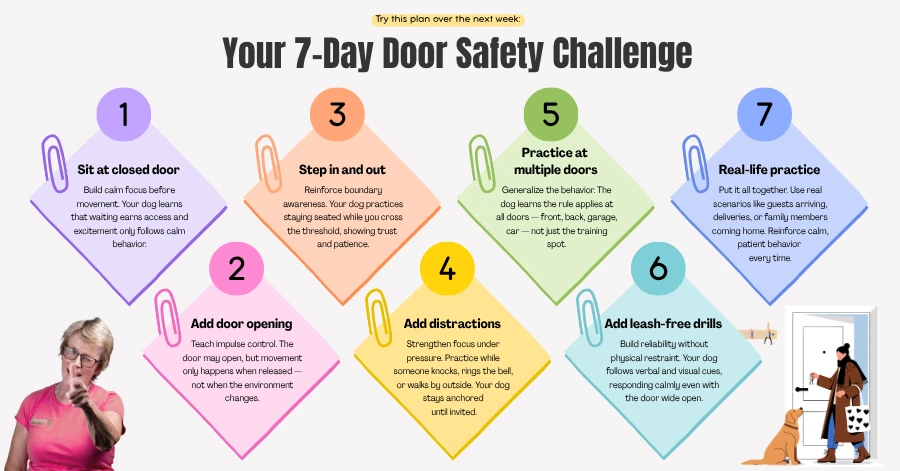
By the end of the week, you’ll see a noticeable shift. Your dog will look to you for direction instead of taking matters into their own paws.
Your door is more than an exit — it’s a training zone.
Every time you open it, you have a chance to reinforce structure, calm, and trust.
If you’re tired of the chaos, start with small steps. Consistency builds reliability, and reliability keeps your dog safe.
Remember: good manners aren’t about control. They’re about communication.
When your dog understands what you expect at the door, safety becomes second nature.
If you found this helpful, you’ll love the deeper dives I share every week
🎧 Listen to my podcast, Paws and Profits — where I talk about the real work behind great dog training, share stories from the field, and help you understand the “why” behind calm, connected leadership.
📺 Watch my latest training videos on YouTube — real dogs, real people, real progress. You’ll see how small changes in structure and mindset transform daily life at the door and beyond.
And if you’re ready to work directly with me, you can book an online training sessions. You’ll get personalized support, clear structure, and practical solutions you can start using right away — all from the comfort of your home.
You can find everything — my podcast, YouTube channel, and online coaching options — at https://ontariodogtrainer.com.
Start today. Teach calm, lead clearly, and keep your dog safe every time the door opens.