
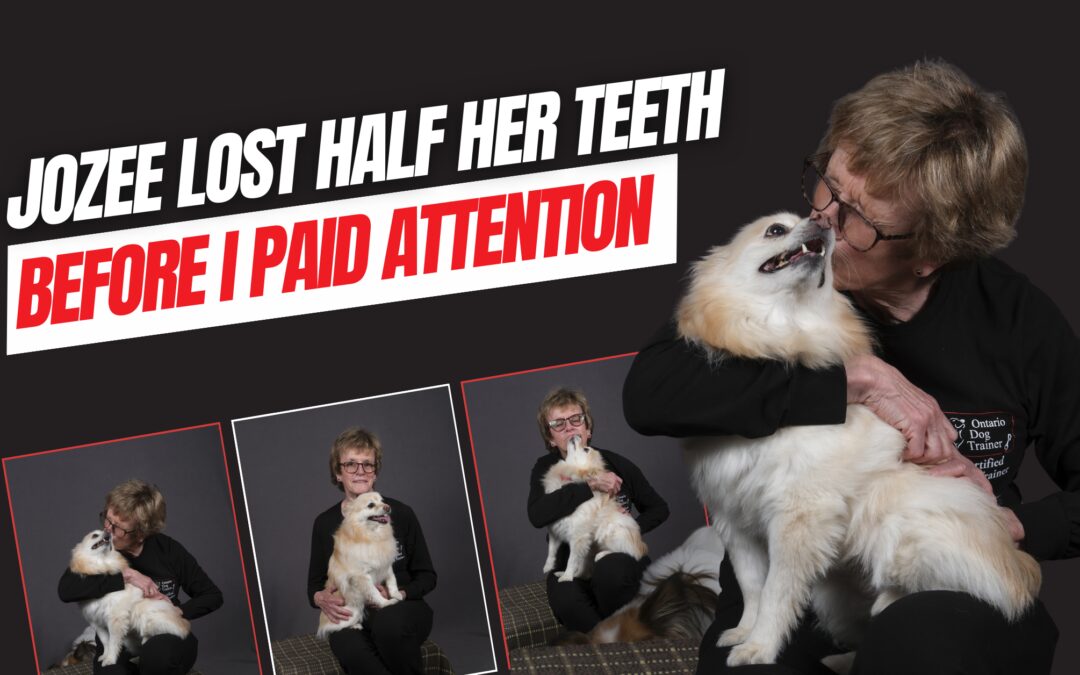
Jozee’s Story, One Year Later
Let’s be real for a moment.
How often do you actually look at your dog’s teeth?
Not glance. Not assume. Really look.
Most people don’t. And I didn’t either.
We tell ourselves all the usual things. Dogs in the wild don’t brush. Raw food will handle it. Small dogs just have “dog breath.” It’s easy to downplay dental care because the problems are quiet. Teeth don’t scream for attention. They just deteriorate slowly, right under the surface.
This article is a departure from my usual behaviour and training topics, but it matters. Because a dog living with chronic dental pain is not a dog set up for success in training, learning, or daily life.
Why Dental Health Belongs in a Training Conversation
I’ve spent decades helping people improve behaviour through structure, clarity, and relationship. But here’s the part that often gets missed.
Pain changes behaviour.
A dog with inflamed gums, infected roots, or a mouth that hurts every time they chew is not operating from a calm nervous system. They are uncomfortable, sometimes miserable, and often labelled as “slowing down,” “grumpy,” or “just getting older.”
Sometimes, they are just hurting.
My Hard Lesson With Jozee
If you’ve followed my work for any length of time, you’ve heard about Jozee, my Pomeranian.
During the pandemic, my vet recommended a dental cleaning. I hesitated. The cost felt steep. Her teeth looked “fine enough.” I told myself I’d keep an eye on things.
That decision cost Jozee 21 teeth.
By the time I finally said yes to the cleaning, the damage underneath the gum line was severe. One infection had begun spreading into her nasal cavity. The breath was awful. Her eyes were goopy. Her coat dulled. And her spark? It was fading.
I didn’t miss it because I didn’t care.
I missed it because dental disease is sneaky.
The photos taken by the care team at Peterborough West Animal Hospital told the truth I hadn’t seen. Thick tartar, angry gums, hidden infections. The after photos show stitches and extractions, not healing yet, but relief had already begun.
One Year Later: Jozee at 10
Here’s the part I really want people to hear.
Jozee is now 10 years old.
She has far fewer teeth.
And she is more lively, more engaged, and more comfortable than she was several years ago with her teeth.
Her energy is better. Her expression is brighter. She eats happily. She interacts more. She moves through her day without that quiet, constant discomfort dragging her down.
This is not about aesthetics.
This is about quality of life.
Signs Your Dog’s Teeth Need Attention
If you’re waiting for a dramatic sign, don’t. Look for the quieter ones.
- Breath that is foul, not just “doggy”
• Yellow or brown buildup along the gum line
• Red, swollen, or bleeding gums
• Goopy eyes or chronic tear staining
• Chewing on one side or avoiding harder food
• Lower energy or irritability that seems unexplained
Behaviour changes often get blamed on age. Sometimes, it’s just pain.
Groomer Cleanings vs Veterinary Dental Care
This matters.
Groomer cleanings are cosmetic. They address surface plaque only. They cannot assess below the gum line, cannot deal with infection, and cannot extract damaged teeth.
Veterinary dental cleanings are medical procedures. They include full scaling above and below the gum line, X-rays when needed, and extractions that prevent infection from spreading further into the body.
There is no comparison.
Common Myths Worth Letting Go
“Raw food prevents dental disease.”
Sometimes it helps. Sometimes it doesn’t. Breed, genetics, and mouth structure matter.
“Bad breath is normal.”
It’s common, not normal.
“Anesthesia is too risky.”
Modern veterinary protocols make the risk far lower than leaving infection untreated.
What Dental Health Changes in Training
This is where it loops back to my world.
When a dog is no longer living with chronic oral pain, you often see improvements in focus, tolerance, and willingness to engage. Training becomes easier not because you changed your technique, but because the dog feels better.
Calm is hard to access when something hurts all the time.
February Is Dog Dental Health Month
Here’s your practical next step.
February is Dog Dental Health Month, and many veterinary clinics offer dental promotions or discounts during this time. If your vet has ever suggested a dental cleaning, this is the month to revisit that conversation.
Not next year.
Not “we’ll see.”
Now.
Final Thought
If I could go back, I would have listened sooner. Jozee’s recovery showed me just how much she had been compensating for discomfort I didn’t fully see.
She’s not younger.
She’s just healthier.
And that makes all the difference.
If you’re unsure, book a dental exam with your veterinarian and ask honest questions. Your dog’s behaviour, comfort, and long-term health are worth it.
If you found this helpful, you’ll love the deeper dives I share every week
🎧 Listen to my podcast, Paws and Profits — where I talk about the real work behind great dog training, share stories from the field, and help you understand the “why” behind calm, connected leadership.
📺 Watch my latest training videos on YouTube — real dogs, real people, real progress. You’ll see how small changes in structure and mindset transform daily life at the door and beyond.
And if you’re ready to work directly with me, you can book an online training sessions. You’ll get personalized support, clear structure, and practical solutions you can start using right away — all from the comfort of your home.
You can find everything — my podcast, YouTube channel, and online coaching options — at https://ontariodogtrainer.com.
Start today. Teach calm, lead clearly, and keep your dog safe every time the door opens.