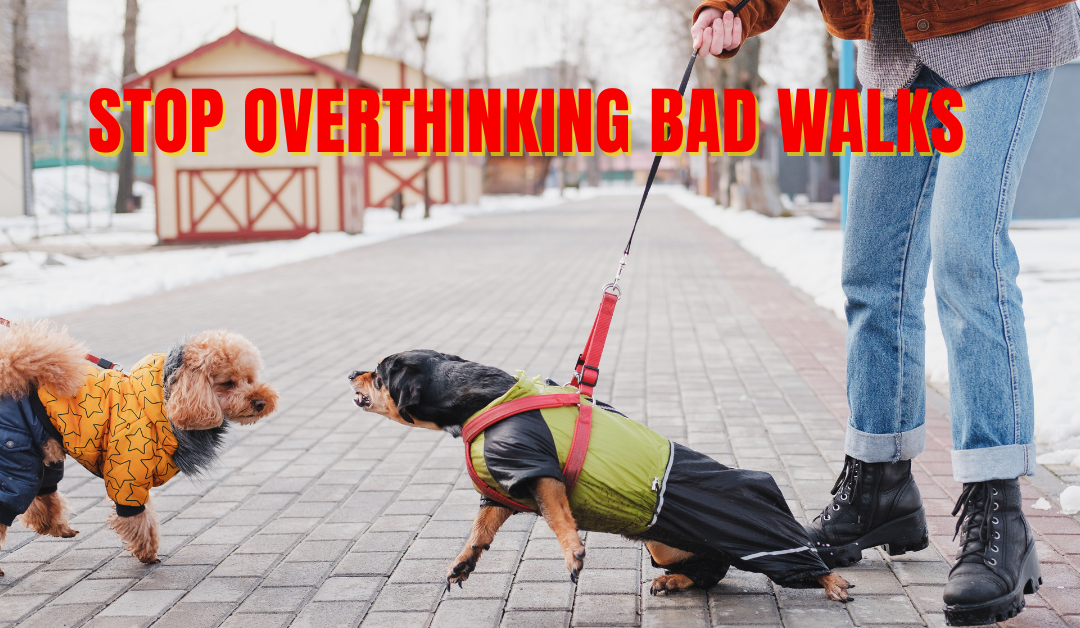
Not every walk is going to be a good one.
Some days your dog walks well, checks in, stays connected, and makes you think, “Look at US, walking together like bread and butter – being CIVILIZED.”
Other days, your dog barks at another dog, lunges at a squirrel, tangles the leash around your legs, and leaves you standing there wondering if any of your training is actually working.
That behaviour doesn’t mean your training isn’t working.
It means you had a bad walk.
And one bad walk doesn’t mean you or your dog have failed.
This is an important lesson for dog owners because many people don’t struggle most with the walk itself. They struggle with what they make up in their heads afterward about the ‘bad walk’.
They go home discouraged.
They replay the incident over and over.
They decide the dog is impossible.
They question everything.
Then they go into the next walk carrying tension, doubt, and frustration.
That’s how one rough walk turns into three more.
Stop calling it a failure
A bad walk isn’t a verdict. It’s not a life sentence. It’s information. That’s it.
That’s the shift.
A rough walk tells you something useful if you’re willing to look at it clearly. Maybe your timing was late. Maybe your dog was more stimulated than usual. Maybe the environment was harder than the one you practiced in. Maybe you were distracted, tired, or emotionally off your game.
That doesn’t make you a bad owner. It makes you a human, handling a dog, in real life.
The problem starts when owners turn one messy moment into a dramatic personal story.
“My dog never listens.”
“He (or she) ruins every walk.”
“I ruin every walk.”
“We’re back at square one.”
Usually, none of that is true.
You just had a rough outing.
The dog has already moved on. You should consider joining them.
What a bad walk is really telling you
When a walk goes sideways, your first job is not to judge it. Your first job is to learn from it.
Ask yourself a few simple questions.
What happened first?
What did my dog notice before the reaction? (aka – what was the behaviour before the behaviour?
What did I miss?
Did I have time or opportunity to act earlier?
What would I do differently next time?
These questions and the answers help you stay practical.
They keep you from spiralling into self-criticism or blaming your dog.
A bad walk often reveals where the next layer of growth is needed. That may be better scanning, earlier movement, calmer handling, more foundation work, or a lower level practice environment.
That is useful information. You can do something with that.
Don’t carry the bad walk into the next one
This matters more than owners realize.
If you go into the next walk still thinking about the last one, your body will show it. Your shoulders will tighten. Your hands will get stiff. Your breathing will change. Your focus will narrow.
Your dog will feel that.
Now your dog is walking with a human who looks like trouble is already expected. That usually doesn’t produce a better result.
If the last walk was rough, the next walk shouldn’t be about redemption. It should be about clarity.
You don’t need to prove anything.
You need to re-establish some success.
Three smart ways to recover after a bad walk
The first is to lower the difficulty on the next walk.
- Don’t go right back into the same challenging environment trying to “fix it.” That’s often just ego wearing sensible shoes.
- Choose an easier route. A quieter time. A simpler setup. Give both you and your dog a better chance to succeed.
The second is to rehearse something you can do well.
- That might be clean movement in your driveway. A few minutes of focused walking in your yard. A short structured walk where the goal is rhythm and connection, not distance or challenge.
- Success rebuilds confidence faster than pressure does.
The third is to review your own mechanics. In other words, review your body language -what were you saying to your dog, without realizing it?
- Did you stop moving?
- Did you hesitate?
- Did you tighten up too early or too late?
- Did you let your emotions stay in the picture too long?
Owners need practice too. Sometimes the dog isn’t the only one who needs better habits.
Recovery is part of leash walking
Too many people think success means the walk went well from start to finish.
That’s not real life.
Real-life dog walking includes missed moments, awkward timing, distractions, and human error. What matters is not whether those things happen. What matters is whether you know how to recover from them.
That’s the real skill.
A confident dog owner is not someone who never has a bad walk. A confident dog owner is someone who has a bad walk, learns from it, resets, and comes back steadier the next time.
That’s leadership.
- If you had a bad walk, don’t let it become your identity.
- Don’t label the whole process a failure because one moment went sideways.
- Take what’s useful. Leave the drama behind. Reset your mind, reset your handling, and go again.
- Your dog doesn’t need perfection from you.
- Your dog needs you to come back organized.
Why this works
You’ll recover faster when you treat bad walks as feedback instead of failure. That mindset leads to better decisions, better practice, and more confidence on your next outing.
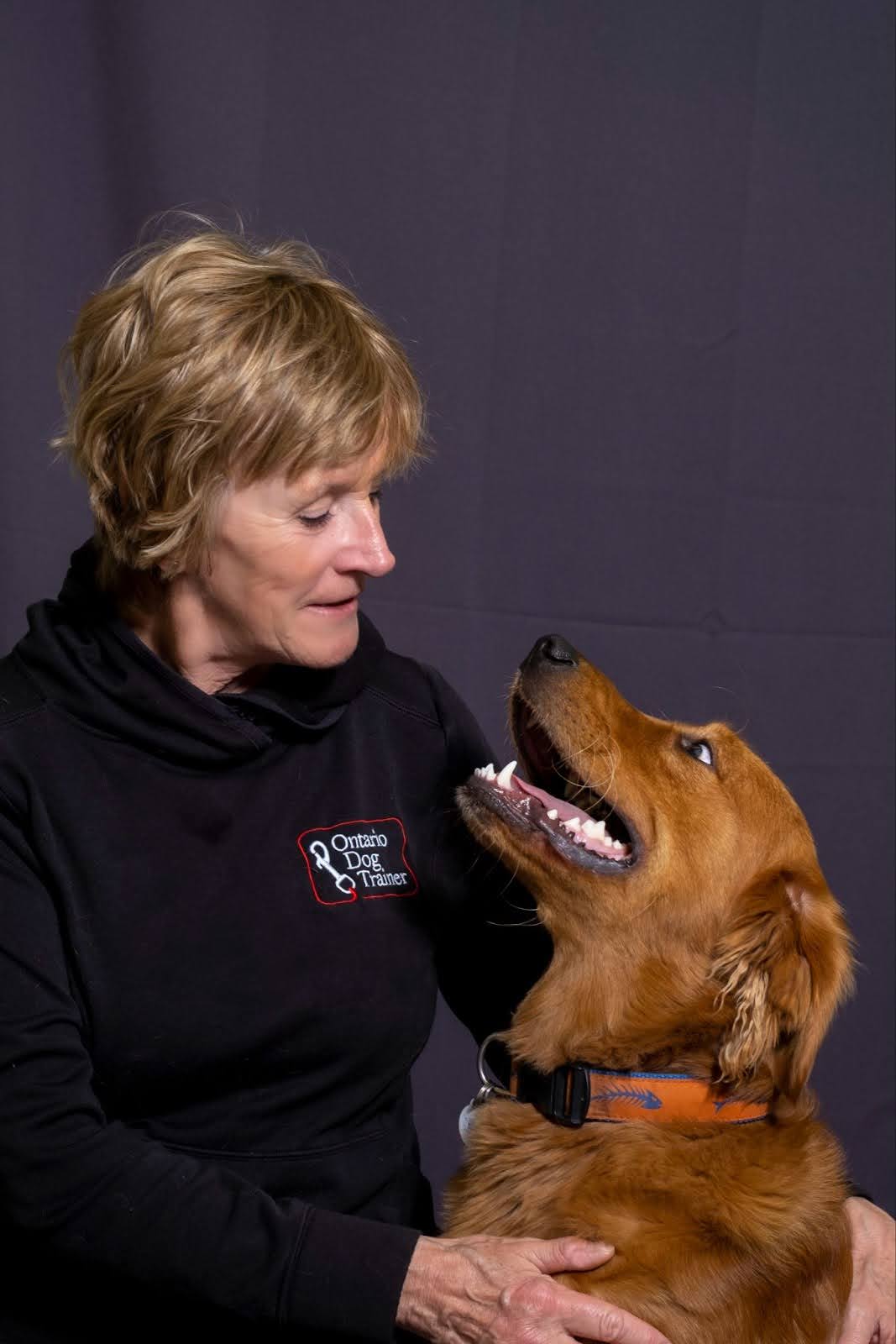 Karen Laws is a certified professional dog trainer, the founder of The Ontario Dog Trainer and the Dog Trainer TRIBE Training Academy. With decades of experience training dogs, educating people, and mentoring aspiring trainers, she is known for her practical, no-nonsense approach to helping both dogs and humans succeed.
Karen’s professional background includes education, public service, wildlife biology, competitive field dog work, and pet dog training. That combination gives her a unique perspective on behaviour, leadership, communication, and what it really takes to create lasting results.
Through her work with dog owners and developing trainers, Karen teaches far more than training exercises. She helps people understand the dog in front of them, improve their communication, and build the kind of confidence that leads to better outcomes in both training and business.
Karen is especially passionate about mentoring pet dog trainers who feel stuck and are ready to grow. Her message is clear, real, and grounded in experience: success in dog training comes from understanding behaviour, building trust, and being willing to do the work.
Follow Karen on Social Media: FaceBook, Instagram, LinkedIn, TikTok, YouTube,
Need personal help? Let’s chat! Click here to book a Virtual assessment!