
Why Your Puppy Is Protesting and What To Do About It
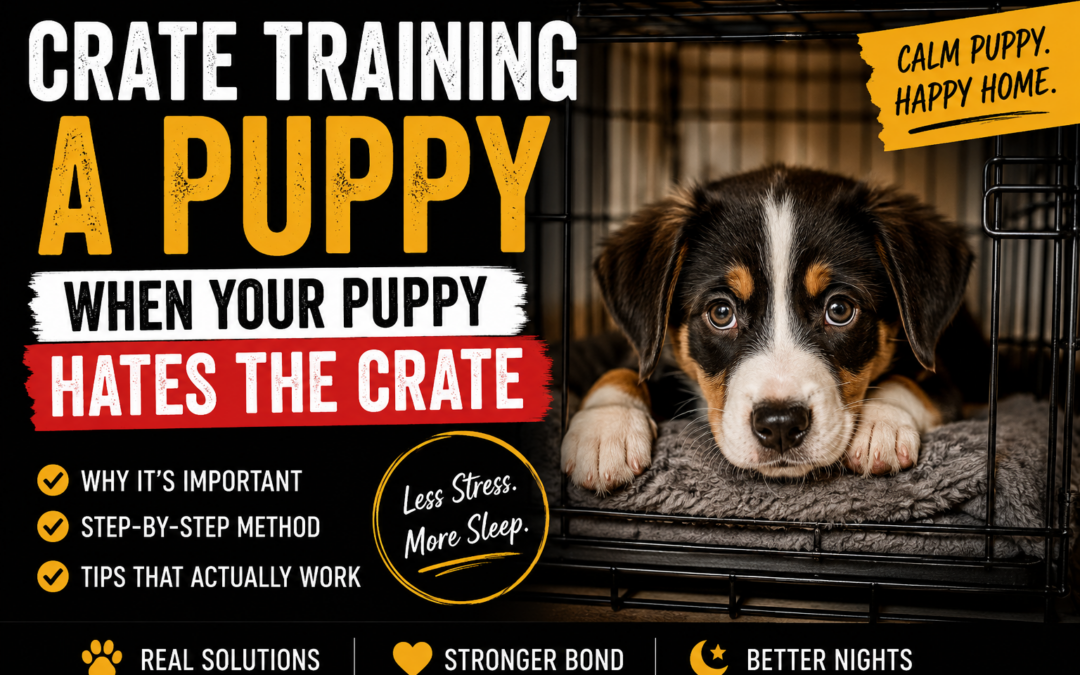
Is your puppy screaming like they have been abandoned in the wilderness every time the crate door closes?
Are you standing there at 2 a.m. wondering if crate training a puppy is supposed to feel this dramatic?
Take a breath.
Your puppy is not broken. You are not failing. And no, this does not mean your puppy will hate the crate forever.
Crate training a puppy is one of the most useful skills you can teach, but it is also one of the first places new owners get stuck. The crate looks simple. Put puppy in. Close door. Puppy sleeps.
That would be lovely.
Also, puppies did not receive that memo.
A crate is not magical. It does not train your puppy for you. The crate is a tool, and like every tool in dog training, it works best when the human using it has a plan.
In this article, we will look at why your puppy may hate the crate, what owners often do by accident to make it worse, and how to build a calm, structured crate routine that helps your puppy learn to settle.
Why Crate Training a Puppy Matters
Before we get into the noise, the protest, and the tiny dramatic performance happening behind the crate door, let’s talk about why crate training matters.
Crate training a puppy helps with:
Potty training.
Preventing destructive behaviour.
Creating a safe resting space.
Teaching your puppy to settle.
Preparing your dog for vet visits, travel, grooming, boarding, and emergencies.
Helping your puppy learn that calm behaviour creates freedom.
That last one matters.
The crate is not just a place to put your puppy when you need a break, although let’s be honest, sometimes that matters too. The crate teaches your puppy how to handle stillness, frustration, and boundaries.
Those are life skills.
A puppy that learns to rest calmly in a crate is easier to live with, easier to travel with, and easier to help through the normal chaos of puppyhood.
Your Puppy Does Not Automatically Understand the Crate
A lot of owners assume puppies should naturally like crates because crates are “den like.”
That sounds nice, but it is not always how the puppy sees it at first.
To your puppy, the crate may feel unfamiliar, limiting, or isolating. They have just left their litter, their breeder, their familiar routines, and everything they knew. Then they arrive in your home, and suddenly everyone expects them to understand sleeping alone, being quiet, and accepting a closed door.
That is a lot for a baby dog.
So when your puppy cries, barks, scratches, or protests, it does not automatically mean they are traumatized. It often means they are confused, frustrated, overstimulated, or learning that noise gets attention.
And puppies are very good at testing systems.
Unfortunately, they do not test them politely.
Why Your Puppy Might Hate the Crate
1. The Crate Feels Unfamiliar
Your puppy may not hate the crate itself. They may hate being separated, confined, or unsure about what is expected.
That is why early crate work should be calm, clear, and repetitive. Your puppy needs to learn that the crate is not the end of the world. It is a resting place.
Not a jail sentence.
Not a punishment.
Not a place where the humans disappear forever.
Just a quiet place to settle.
2. You May Be Moving Too Fast
One of the biggest mistakes in crate training a puppy is rushing the process.
Many owners bring the puppy home, put them in the crate, close the door, turn off the lights, and hope for the best.
Hope is not a training plan.
Your puppy needs short, calm repetitions. They need to go in, come out, eat in the crate, rest near you, and experience the crate without panic or pressure.
You are not trying to win a crate training speed contest. There is no trophy. There is just sleep, sanity, and fewer chewed baseboards.
3. The Puppy Learns That Noise Works
This is where crate training often goes sideways.
The puppy barks.
The owner talks to them.
The puppy whines.
The owner makes eye contact.
The puppy screams.
The owner opens the door.
Now the puppy has learned a very clear lesson.
Noise works.
This does not mean you should ignore true panic, distress, or physical needs. Puppies need potty breaks, support, and appropriate care. But if every protest earns attention, the crate becomes a negotiation.
And puppies are very committed negotiators.
4. Your Puppy Is Not Ready To Rest
Crating a puppy when they are frantic, under exercised, overstimulated, or overtired can create a battle.
Yes, puppies need rest. But many puppies need help shifting into rest.
A short potty break, a few minutes of structured training, calm handling, and a predictable routine can make a huge difference.
You want your puppy going into the crate with a body and brain that are ready to settle.
Not bouncing off the walls like a tiny caffeine powered raccoon.
What Not To Do When Crate Training a Puppy
When crate training a puppy, avoid these common mistakes:
Do not use the crate as punishment.
Do not shove your puppy into the crate.
Do not open the door because your puppy is barking.
Do not let every family member use different crate rules.
Do not expect the crate to fix behaviour without training.
Do not turn every crate exit into a stampede.
That last one is important.
Most owners focus on getting the puppy into the crate. They forget that coming out of the crate is also training.
If your puppy explodes out of the crate every time the door opens, you are teaching excitement, rushing, and poor impulse control.
Calm exits matter.
A lot.
The Crate Training Method I Teach First
I teach crate training early because it sets the tone for everything else.
A puppy that learns to settle, wait, and respond calmly around the crate is already learning structure. That structure carries into leash work, doorway manners, feeding routines, grooming, travel, and general household behaviour.
Here is the method I use.
Step 1: Use a Flat Grab Collar
Your puppy should have a flat collar in the crate.
Not a training collar.
Not a slip collar.
Not anything that could tighten or catch.
A flat grab collar gives you a safe way to guide your puppy when needed. It is not there for pulling or correcting. It is simply a handle.
When your puppy exits the crate, you can calmly clip the leash to the grab collar and guide them with control instead of grabbing, chasing, or reacting.
Calm handling starts before the door even opens.
Step 2: Teach Calm Entry
Do not toss your puppy into the crate.
Do not push them in.
Do not make it weird.
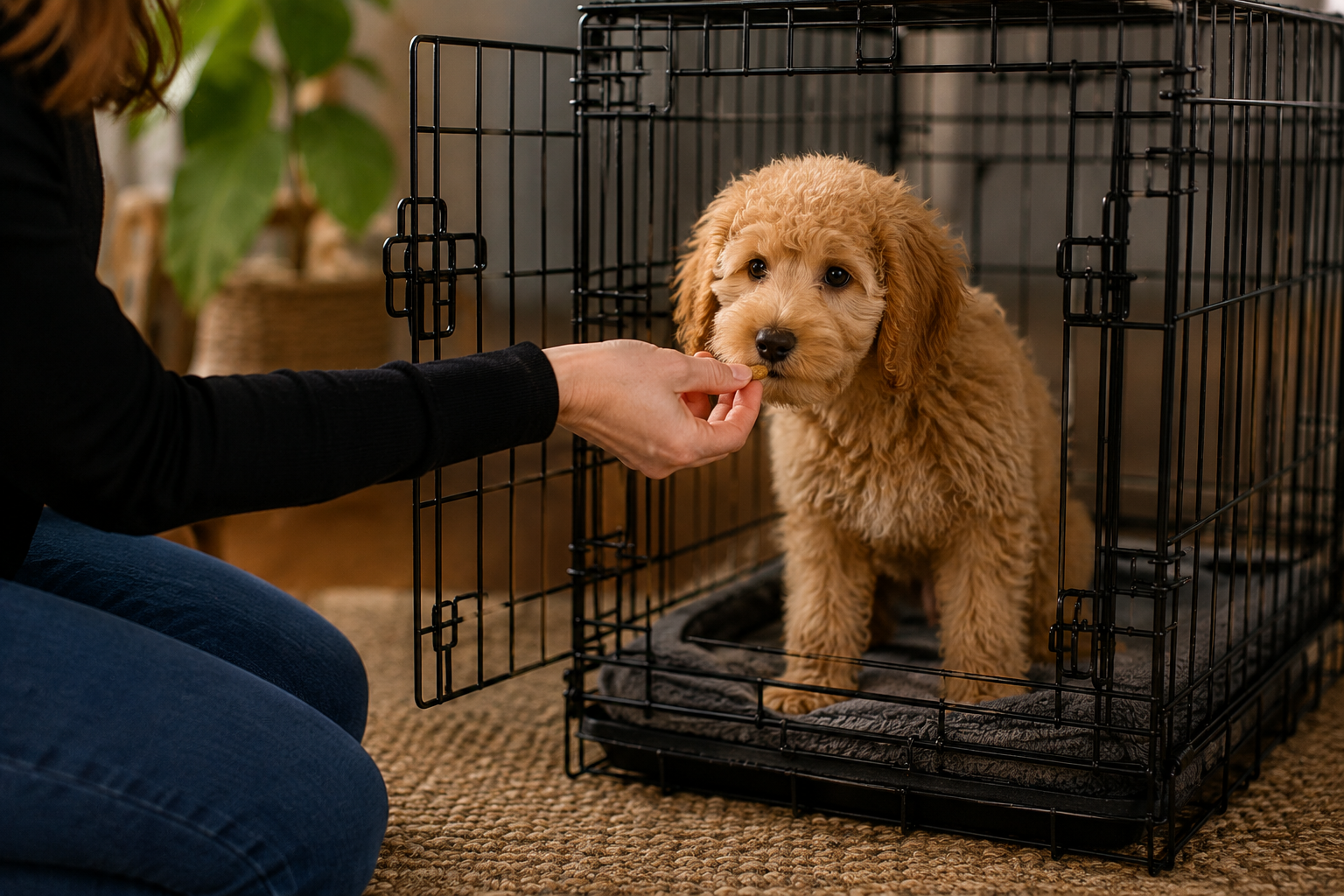
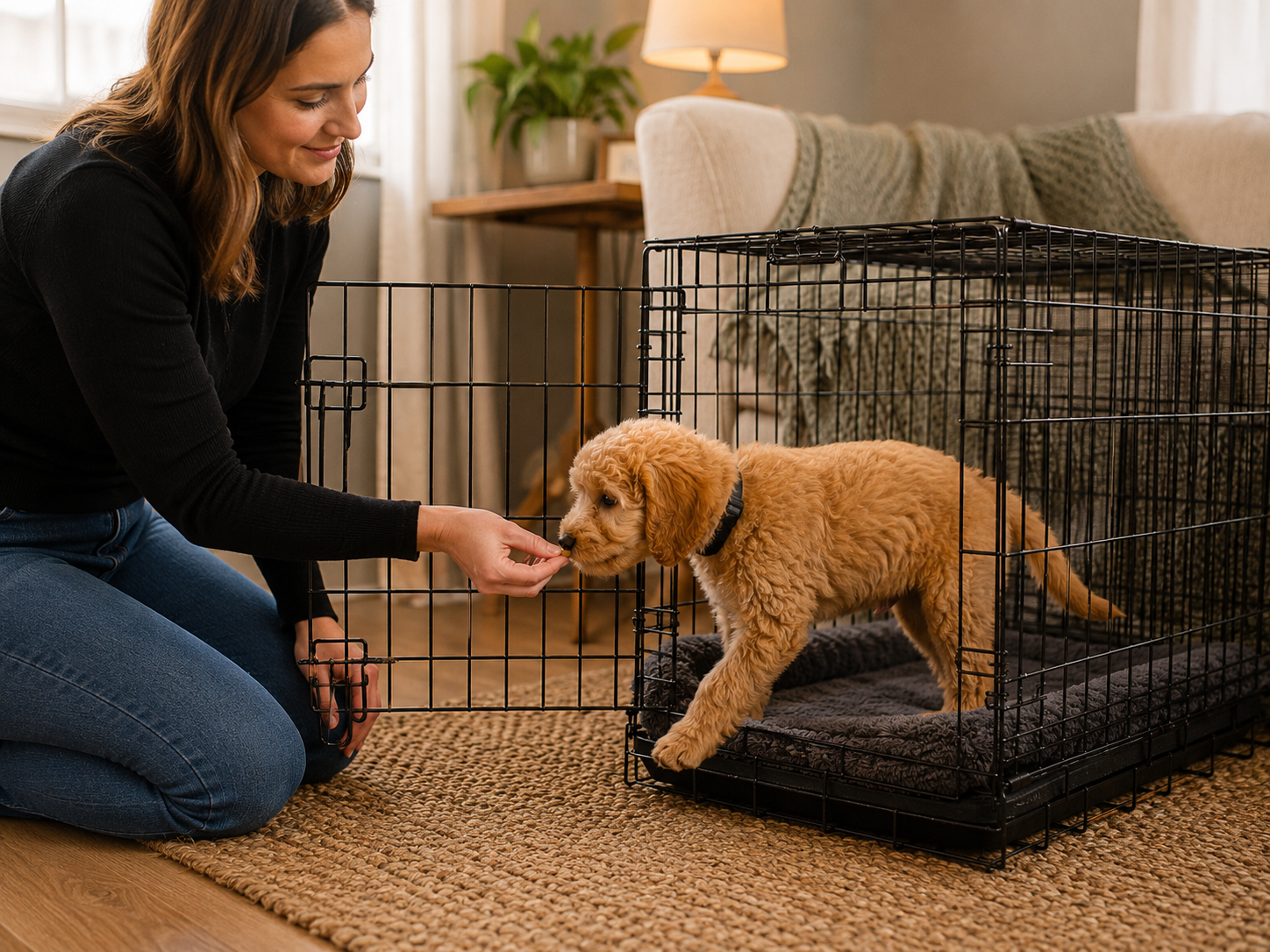
Use food. Keep your energy calm. Say “crate,” place or toss a treat inside, and let your puppy go in willingly.
At first, you may leave the door open. Let your puppy explore the crate without pressure. Feed meals in the crate. Scatter a bit of kibble inside. Let the crate become part of everyday life.
The goal is simple.
The crate predicts good things.
Food happens there. Rest happens there. Calm happens there.
And yes, sometimes the door closes there.
That part comes with practice.
Step 3: Stop Making a Big Production Out of the Crate
Puppies read us far better than most people realize.
If you hover, fuss, apologize, soothe, or make crate time feel like an emotional event, your puppy may believe there is something to worry about.
Be calm.
Be matter of fact.
Put the puppy in. Close the door. Move on.
This does not mean being cold. It means being steady.
Your puppy does not need a dramatic farewell speech.
They need leadership.
Step 4: Make Calm Exit Part of the Training
This is the part most owners skip.
The puppy has been in the crate. The owner opens the door. The puppy launches out like a bottle rocket.
Then everyone wonders why the puppy is frantic, mouthy, and hard to manage.
Crate exits teach your puppy how to move from confinement into freedom. That transition matters.
Here is how to teach it.
Open the crate door only slightly.
Reach in calmly if needed.
Guide your puppy back if they rush forward.
Wait for calm.
Ask for a sit if your puppy knows it.
Mark the calm behaviour with “yes.”
Clip the leash to the flat grab collar.
Invite your puppy out when they are calm.
Then ask for another sit outside the crate.
This may feel slow at first. Good.
Slow is how puppies learn.
Repeat this several times. Build the habit. You are not just teaching the puppy to exit a crate. You are teaching the puppy that calm behaviour opens doors.
Literally.
Step 5: Time Crate Sessions Properly
Timing matters when crate training a puppy.
Crate your puppy after:
A potty break.
A short play session.
A bit of structured training.
A few minutes of calm handling.
Avoid crating when your puppy is frantic, under stimulated, or already in full protest mode.
Also avoid crating right after a full meal unless you are following a specific routine and your puppy is comfortable. Many puppies need a chance to toilet after eating, and crating too soon can make everyone’s life harder.
Especially yours.
How Long Can a Puppy Stay in the Crate?
Your puppy’s age matters.
A general guideline I use is:
Daytime, about 1.25 hours per month of age.
Overnight, about 1.5 hours per month of age.
So a 10 week old puppy may manage about 2.5 hours during the day and a little longer overnight, depending on the puppy, their schedule, and their ability to stay clean.
This is not a rigid law. It is a guideline.
Some puppies need more potty breaks. Some settle faster. Some take longer. Small breed puppies may need more frequent breaks. Puppies with upset stomachs, stress, or changes in food may also need extra support.
Crate training is not about forcing a puppy to hold it beyond their ability.
It is about building routine, confidence, and calm.
How To Make the Crate a Positive Place
Feed Meals in the Crate
Food builds value.
Feed meals in the crate with the door open at first. Once your puppy is comfortable, close the door briefly while they eat. Open it before they panic or fuss.
You are teaching your puppy that the crate is normal.
Not exciting.
Not scary.
Normal.
Normal is good.
Use Short Crate Games
You can play simple crate games throughout the day.
Say “crate.”
Toss a treat inside.
Let your puppy go in.
Praise calmly.
Let them come out.
Repeat.
Once your puppy understands the game, add tiny moments with the door closed. One second. Three seconds. Five seconds.
Build gradually.
Do not wait until bedtime to start crate training. That is like trying to learn how to swim during a shipwreck.
Add Calm Presence
In the beginning, your puppy may settle better if you stay nearby.
Sit in the room. Read. Work quietly. Let your puppy hear you moving around.
Do not stare into the crate. Do not talk every time they fuss. Just be present and calm.
Your calm helps teach their calm.
What To Do When Your Puppy Cries in the Crate
This is where owners struggle most.
You do not want to ignore a puppy who truly needs help. But you also do not want to teach your puppy that barking opens the door.
So ask yourself:
Did my puppy recently have a potty break?
Has my puppy had appropriate activity?
Is my puppy safe?
Is this protest or panic?
If your puppy is safe, recently toileted, and simply protesting, wait for even a tiny moment of quiet before opening the crate or giving attention.
Reward the behaviour you want.
Not the soundtrack you are trying to survive.
If your puppy truly needs to toilet, take them out calmly and boringly. No play. No party. Potty break only. Then back to the crate.
The message is clear.
Needs are met.
Drama does not run the household.
When Crate Protest Becomes Crate Panic
Some protest is normal.
Puppies may bark, whine, paw at the door, or object to the change in routine. That does not always mean something is wrong.
But crate panic is different.
Watch for:
Heavy drooling.
Repeated loss of bowel control.
Frantic digging or attempts to escape.
Panting and pacing that does not settle.
Extreme distress that continues for long periods.
A puppy showing those signs may need a slower plan, a different crate setup, or professional guidance.
Do not try to “tough it out” with true panic. That can make the crate worse.
Training requires judgment. Annoying puppy protest and real fear are not the same thing.
One is loud learning.
The other needs help.
Where Should the Crate Go?
Choose a calm area of your home.
Not completely isolated.
Not in the busiest traffic zone.
Your puppy should be able to rest without being constantly disturbed, but they should not feel banished from the household.
For many puppies, a crate near the bedroom works well at night, especially during the early adjustment period. During the day, a crate in a quiet main floor area can help the puppy learn to rest while normal life happens around them.
You may eventually have more than one crate location.
Convenience matters. If the crate is only in some far corner of the house, you are less likely to use it consistently.
And consistency is the whole point.
Crate Training Is Not About Locking Your Puppy Away
Let’s be clear.
Crate training a puppy is not about warehousing your dog.
It is not a replacement for training, exercise, engagement, or supervision.
The crate is part of a healthy routine.
Your puppy still needs:
Potty breaks.
Training.
Play.
Social exposure.
Rest.
Leadership.
Time with you.
The crate works best when it is balanced with an appropriate daily rhythm. Too much freedom creates chaos. Too much crating creates frustration.
The sweet spot is structure.
And yes, that does mean the human has to participate.
Shocking, I know.
The Real Goal of Crate Training a Puppy
The goal is not just to get your puppy quiet.
Quiet is nice, especially at 2 a.m., but it is not the whole picture.
The real goal is to teach your puppy to:
Settle.
Wait.
Handle frustration.
Trust your guidance.
Move calmly in and out of confinement.
Accept boundaries without falling apart.
Those skills show up everywhere.
A puppy that can settle in a crate can often settle better on a leash, in the car, at the vet, in a campground, at a family gathering, or during a busy day at home.
The crate is one of the first places your puppy learns that calm behaviour works.
You Are Not Failing. You Are Training.
Crate training a puppy can feel hard in the beginning.
It may test your patience.
It may interrupt your sleep.
It may make you question your life choices briefly while standing in your hallway in pajamas at 3 a.m.
But that does not mean it is not working.
Puppies learn through repetition. They learn through consistency. They learn through calm handling and clear routines.
The crate is not a punishment.
It is a boundary.
And good boundaries help puppies feel safe.
Stay steady. Keep the routine simple. Reward calm behaviour. Do not negotiate with noise. Watch for true distress. Adjust when needed.
Your puppy does not need perfection.
Your puppy needs consistency.
Need Help With Crate Training?
If your puppy hates the crate, you do not have to keep guessing.
Download my free crate training checklist and use it as a simple guide to build calmer crate entries, calmer exits, and a better daily routine.
And if you are stuck, tired, or unsure whether your puppy is protesting or panicking, book a virtual coaching session. We can troubleshoot what is happening and create a plan that fits your puppy, your home, and your actual life.
Because crate training should make life easier.
Not turn your house into a nightly opera.