
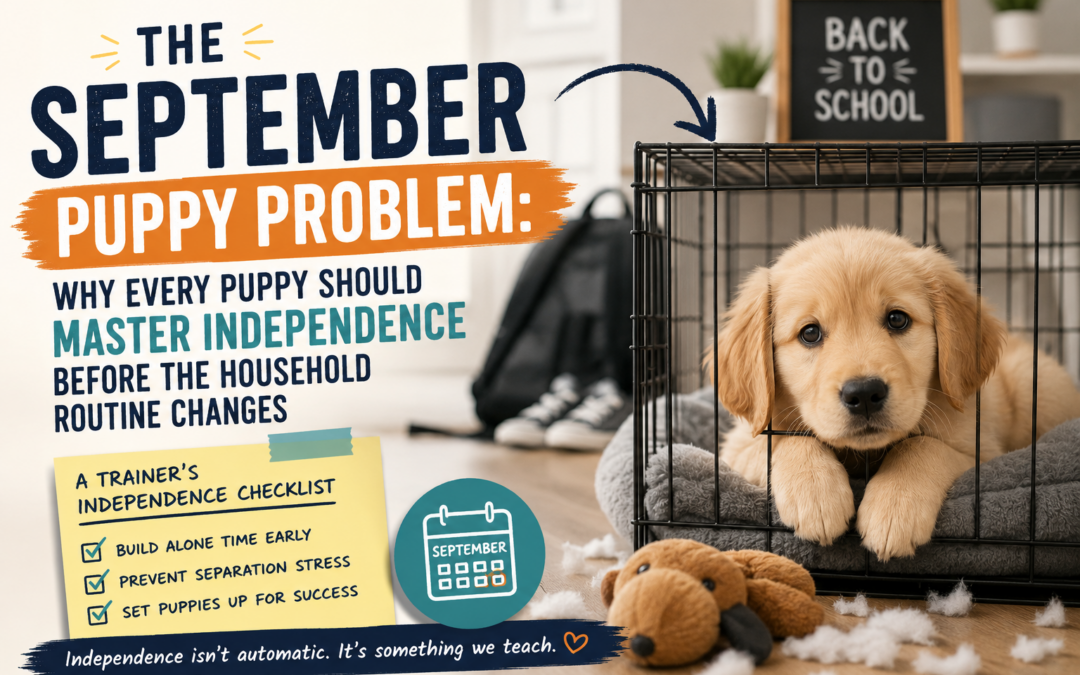
Quick answer: Puppies raised through summer or during busy holiday seasons often get near-constant human company. Then September hits, or the holiday season ends. Schedules snap back to normal, and the puppy who’s never practiced being alone starts showing it: barking at departures, shredding the crate bedding, shadowing every footstep. The fix isn’t a seasonal holiday emergency plan. It’s building independence into the puppy program from week one, the same way you’d build recall or leash skills.
Read time: ~7 minutes. Written for trainers and new puppy owners building or refining puppy training programs.
For Puppy Trainers and Busy Puppy Owners
Summer puppies get unusually high amounts of human company because when school’s out, holidays happen, doors open and close all day, and people are constantly present.
- When the school-and-work routine returns, that company disappears fast, and puppies without practice being alone can struggle.
- Independence is a trainable skill, not something that develops on its own, and must be treated with the same intention as the foundational skills of sit, down, or recall.
- Whether you’re a trainer helping a new puppy owner, or a new puppy owner reflecting on what life with your new puppy will look like, ask this one important question to build a successful puppy-to-adult-dog lifestyle: “Describe your dog’s normal life six months from now.” The gap between that answer and the puppy’s current routine is your training plan.
- Not every whine is separation anxiety, but genuine distress deserves a real behaviour plan, not a shrug.
What Is the “September Puppy Problem”?
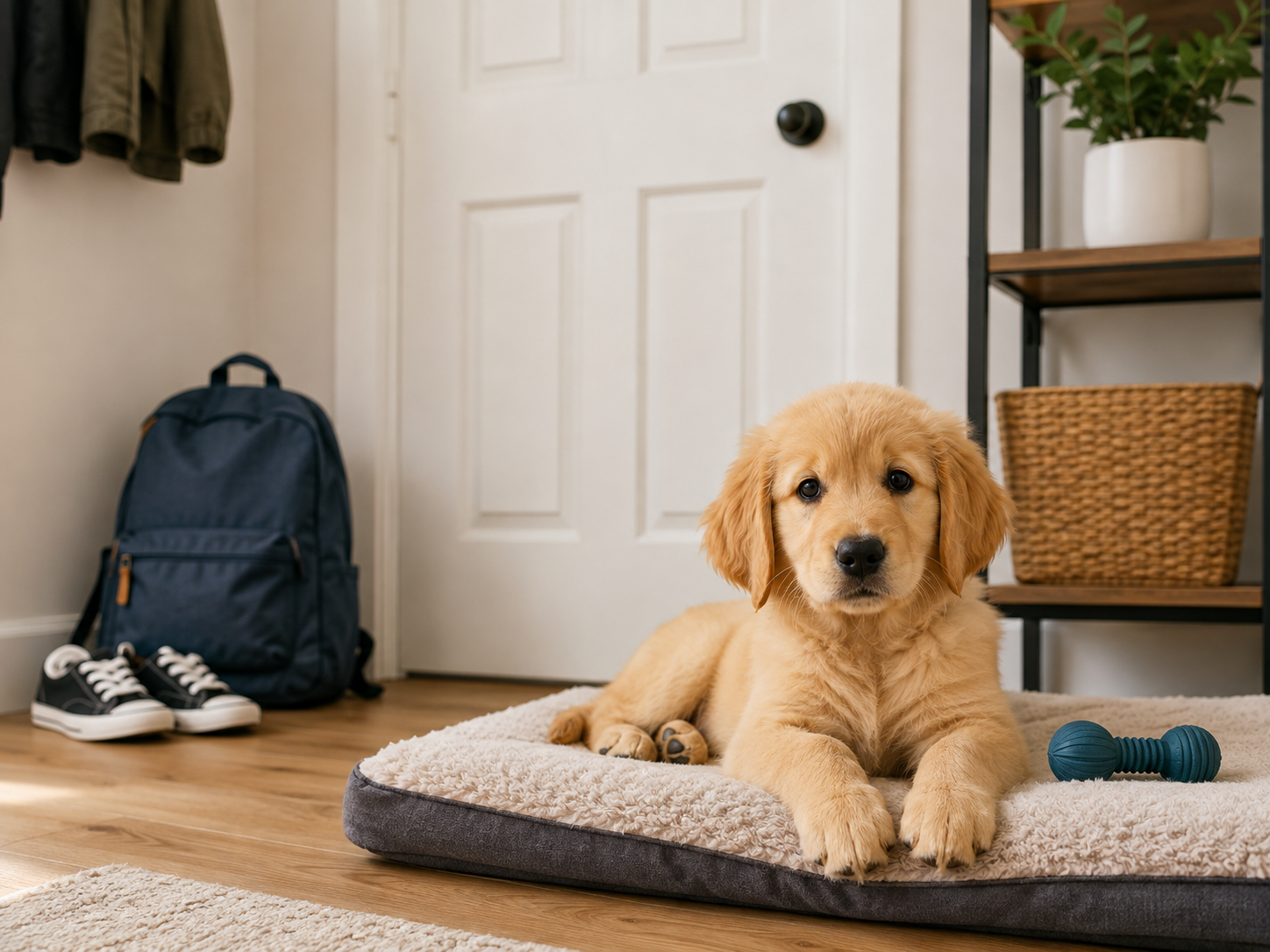
The September puppy problem is what happens when a puppy raised during a high-attention season — summer break, holidays, a newly-adopted-and-doted-on phase — is suddenly expected to tolerate long stretches alone once school or work schedules resume. Because the puppy was never taught that solitude is normal, the abrupt change can trigger destructive behaviour, crate protest, or shadowing.
It isn’t really about the calendar. It’s about any mismatch between the routine a puppy was first introduced to and the routine it’s actually going to live.
Why Summer Puppies Are Especially at Risk
Think about a typical puppy who arrives in a home in late spring or summer:
- People are outside more.
- Kids may be home from school.
- Families take holidays and bring the puppy along.
- Friends and visitors drop by constantly.
- Doors open and close all day.
From the puppy’s point of view, life is one long social event.
Then the routine resets. The alarm goes off earlier. People leave for work. Kids leave for school. The house goes quiet — and the puppy who’s spent two months with company constantly available is suddenly alone for hours. That’s a big behavioural ask for a dog with zero practice.
This is exactly when trainers start fielding calls like:
- “He suddenly hates his crate.”
- “She’s barking every time we leave.”
- “He’s destroying things.”
- “She follows me everywhere now.”
- “I don’t know what happened — she was perfect before.”
Something did happen. The dog’s life changed, and nobody trained for the new version of it.
Independence Is a Trainable Skill. It’s Not a Given
Independence deserves the same deliberate training as recall or loose-leash walking. A puppy needs to learn two things that aren’t contradictory at all:
- Being with people is enjoyable.
- Not being with people is completely normal.
The goal is a dog that enjoys engagement without requiring it; one that can be part of the family and then switch off when nothing’s happening. That skill doesn’t show up on a puppy’s first birthday by default. You build it, one rehearsal at a time.
The Trap: Becoming the Puppy’s Full-Time Entertainment Department
Most owners fall into this without meaning to. The pattern looks like this:
The puppy wakes up → someone plays with it. The puppy wanders → someone interacts. The puppy brings a toy over → someone throws it. The puppy follows → someone talks to it. The puppy gets restless → someone finds a new activity to “tire the puppy out.”
Then everyone wonders why the puppy never learned to settle. Nobody taught it how to! The household accidentally taught the opposite: movement gets attention, pestering gets interaction, and following a human produces entertainment; quiet time is optional.
Worth saying clearly to puppy owners: you didn’t ruin your puppy. You were trying hard to be good owners, sometimes too hard.” This is a coaching moment, not a failure to flag.
Rest Is a Skill Too: Teach It on Purpose
A well-rounded puppy program isn’t just eat, train, play, explore on repeat. It needs rest built in as its own skill. A young puppy doesn’t need eight hours of recreational programming a day. Constant stimulation can actually produce the dog owners later complain about: one that’s always hunting for the next activity.
Crates, pens, place training, and puppy-proofed downtime spaces all teach the same underlying lesson: nothing exciting happening right now is not an emergency. That’s a foundational life skill, not a side effect.
Puppy Intake Questions That Predict End-of-Holiday Behaviour Problems
This is a conversation worth having at the beginning, before the training plan is even written. Ask:
- Who is currently home during the day?
- Will that change with the puppy’s daily routine when school starts, or when a work-from-home arrangement ends?
- How much time has the puppy actually spent completely alone since arrival?
- What happens when the owner walks into another room and closes the door, leaving the puppy alone in a room?
- What will the household’s normal, ongoing weekday and weekend schedule eventually look like?
- How will the puppy fit into the weekday/weekend schedules?
The answers tell you something a puppy sitting on cue never will: whether the current lifestyle resembles the one the puppy will eventually be expected to handle. If it doesn’t, that’s the training plan.
Building Independence Before the Routine Changes
If a puppy has rarely been alone, the answer isn’t to wait until the first day of school and disappear for six hours. Start practicing while people are still around so you can course-correct. That can look like:
- Having the puppy rest while an owner works in another room
- Closing a door occasionally instead of allowing constant shadowing
- Using the crate or a puppy area during the day, not just overnight (For puppy crate training tips, see: Crate Training a Puppy)
- Practicing short, ordinary departures with no drama or emotion, in or out
- Encouraging independent exploration and settling after activity
- Keeping arrivals and departures low-key rather than treating them as events
The exact plan depends on the individual puppy and family lifestyle. This works better as a framework than a checklist.
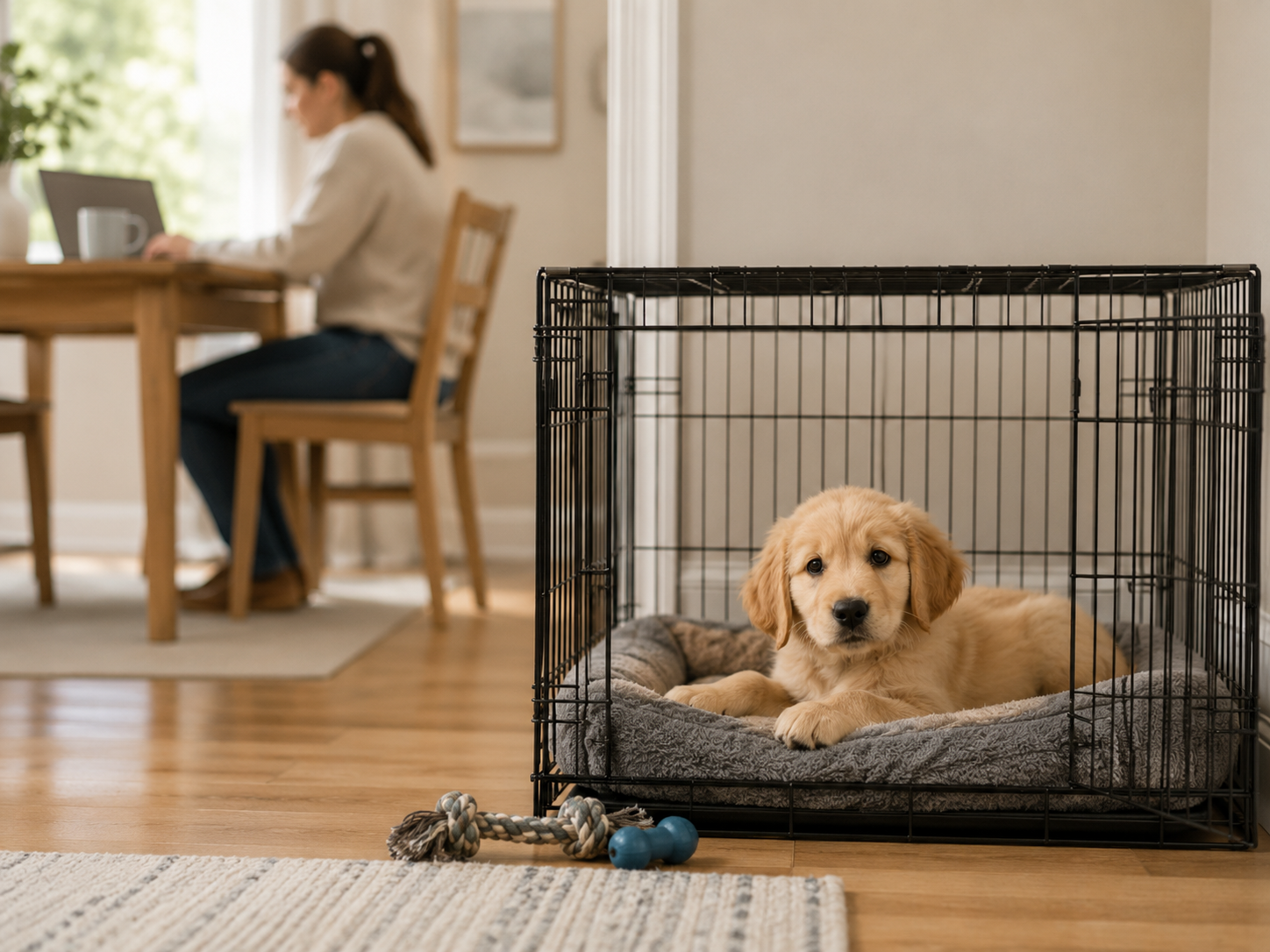
Is It Separation Anxiety, or Normal Puppy Protest?
Not every whine is separation anxiety, and it’s worth saying that plainly and not reaching for the clinical label too fast. At the same time, genuine distress shouldn’t get written off as stubbornness either.
What actually tells you the difference:
- Does the puppy settle, or does the behaviour escalate?
- Can the puppy eat and disengage, or is it fixated the whole time?
- Does the pattern improve or worsen across repeated short absences?
Read this article on Dog Separation Anxiety: Back-to-School Survival Guide.
When the signs point to genuine separation-related distress rather than ordinary inexperience, that calls for a dedicated behaviour plan and, depending on severity, a referral to a veterinarian for possible medical intervention. That’s sound professional judgment, not a training failure.
Socialization Isn’t the Same as Constant Social Contact
One more distinction worth teaching: socialization doesn’t mean take your puppy everywhere and let it interact with everything. (Read: Puppy Training: The Three Things That Matter Most in the First Three Months) A socially capable dog also needs to observe without participating: see another dog and not greet it, watch kids play without joining in or announcing their presence, sit at a park without being entertained, travel somewhere and just sleep.
Sometimes the lesson is interaction. Sometimes it’s observation. Sometimes it’s simply: nothing here concerns you — relax. That range is part of what makes a genuinely functional adult dog.
Train for the Adult Dog, Not Just the Puppy in Front of You
Every puppy training session and interaction should be building toward the six-month-old, the one-year-old, the two-year-old dog, not just today’s cute trick. The better questions to ask aren’t “Can your puppy sit?” but:
- Can your puppy follow a human without needing constant interaction?
- Can it recover from something unexpected?
- Can it accept boundaries and handle age-appropriate frustration?
- Can it rest and disengage on its own?
- Can it spend real time without human interaction?
- Does it look to its owner for information when unsure?
Get those foundations solid, and obedience behaviours layer on top far more easily.
The One Intake or Reflection Question Worth Asking as Summer Holidays come to an End
“Describe your dog’s normal life six months from now.”
Then compare that answer to what the puppy is experiencing today. The gap between those two answers is the training plan. A good puppy program shouldn’t just produce a dog that knows commands. It should produce a young dog capable of living successfully in the world it’s actually going to be asked to live in. And sometimes the most important lesson isn’t another cue. It’s learning that people can leave the room and the world doesn’t end.
FAQ: Puppy Independence & Fall Routine Changes
What is the “September puppy problem”? It’s the behavioural fallout that happens when a puppy trained around a high-attention summer schedule is suddenly left alone for long stretches once school or work routines resume. Behavioural fallout often shows up as barking, destructive chewing, soiling in the house and/or crate, or crate refusal.
How do I teach my puppy to be okay being alone? Practice short, low-key departures while people are still home, use crate or pen time during the day (not just overnight), and avoid entertaining the puppy every waking minute so it learns that downtime is normal, not a warning sign.
Is my puppy’s whining at the door separation anxiety? Not necessarily. Look at whether the behaviour settles over time or escalates, whether the puppy can eat and disengage, and whether repeated short absences improve the pattern. True separation-related distress usually calls for a dedicated behaviour plan and possibly veterinary involvement.
What questions should be asked to prevent post-holiday puppy behaviour issues? Ask who’s currently home during the day, whether that will change, how much time the puppy has spent truly alone, and what the household’s long-term normal schedule will look like. Build the plan around the gap.
Does socializing a puppy mean it should interact with everything it sees? No. Socialization includes teaching a puppy to observe calmly without participating. That means seeing other dogs, people, or activity without needing to engage with all of it.
Note to Puppy Trainers: If this framework is useful for your practice, consider pairing it with a written intake questionnaire and a simple independence-training handout for clients — both make the “gap analysis” in this article easy to repeat with every new puppy.
Need Help Building the Right Puppy Plan?
Want to build a puppy plan that helps create the lifelong companion you actually want to live with?
We’ve got you.
Book a call with Karen and let’s talk about your puppy, your lifestyle, and the skills that matter most for the dog you want six months, one year, and several years from now.
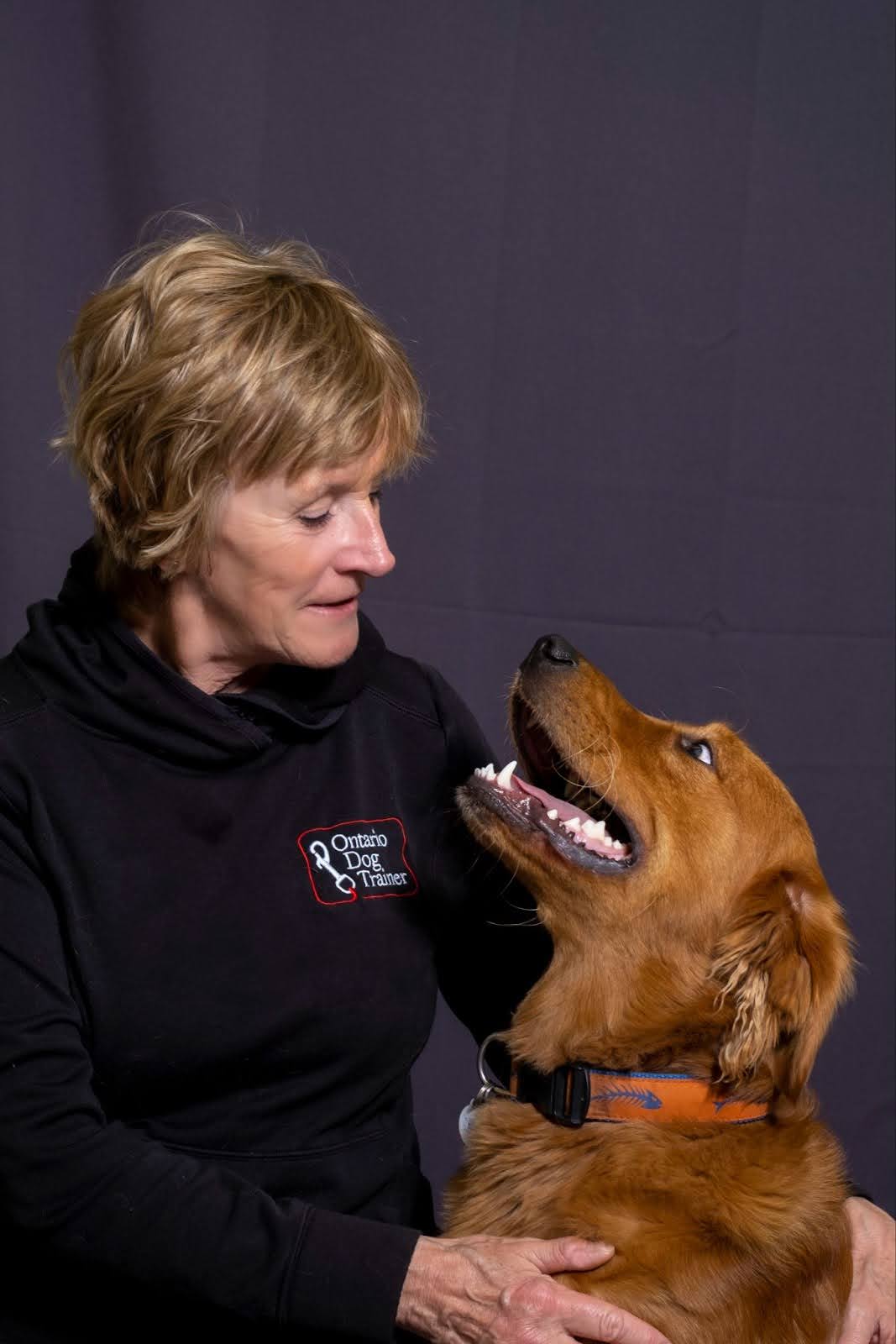 Karen Laws is a certified professional dog trainer, the founder of The Ontario Dog Trainer and the Dog Trainer TRIBE Training Academy. With decades of experience training dogs, educating people, and mentoring aspiring trainers, she is known for her practical, no-nonsense approach to helping both dogs and humans succeed.
Karen’s professional background includes education, public service, wildlife biology, competitive field dog work, and pet dog training. That combination gives her a unique perspective on behaviour, leadership, communication, and what it really takes to create lasting results.
Through her work with dog owners and developing trainers, Karen teaches far more than training exercises. She helps people understand the dog in front of them, improve their communication, and build the kind of confidence that leads to better outcomes in both training and business.
Karen is especially passionate about mentoring pet dog trainers who feel stuck and are ready to grow. Her message is clear, real, and grounded in experience: success in dog training comes from understanding behaviour, building trust, and being willing to do the work.
Follow Karen on Social Media: FaceBook, Instagram, LinkedIn, TikTok, YouTube,
Need personal help? Let’s chat! Click here to book a Virtual assessment!