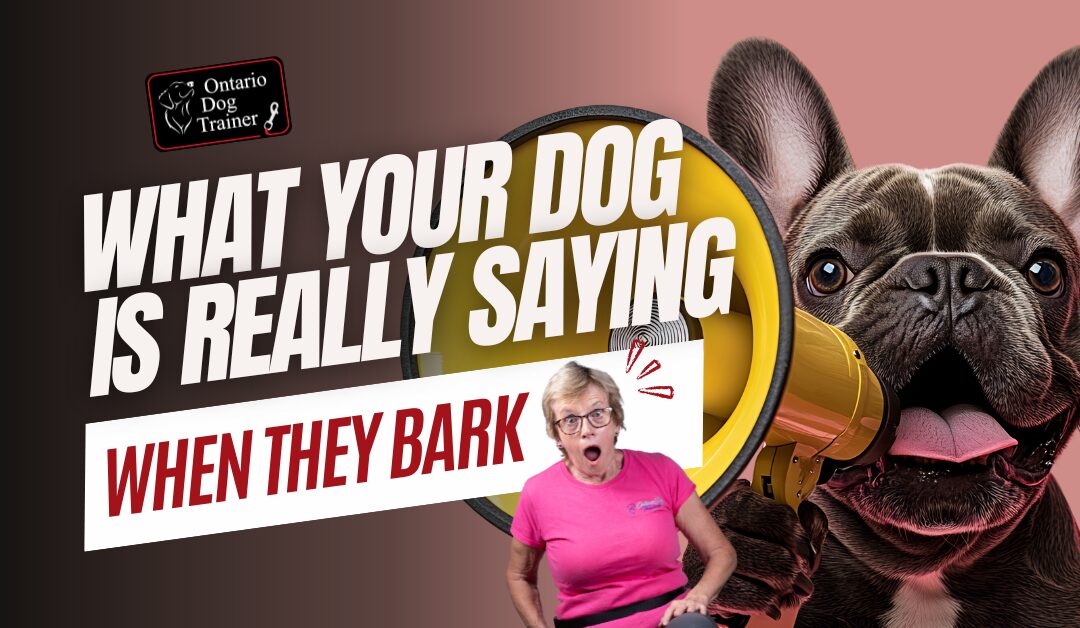
Dog barking is one of the most common reasons people reach out for help. It’s also one of the most misunderstood dog behaviours.
Most owners want the barking to stop.
Most dogs are barking because something is missing.
Before you reach for a collar, a cue, or a frustrated “Enough,” it helps to understand what barking actually is.
Barking is communication.
The problem starts when no one is listening.
First, Let’s Get One Thing Straight
Barking is not disobedience.
It is not dominance.
And it’s rarely about your dog being “bad.”
Barking is information.
Your job is to figure out what problem your dog is trying to solve and whether they have been left to solve it on their own, or even have the education needed to do so.
First, Let’s Get One Thing Straight
As veterinarian and behaviourist, Dr. Bruce Fogle, in his revolutionary book ‘The Dog’s Mind, Understanding Your Dog’s Behavior, (1990), has long emphasized that dogs use vocalization as one of several tools to communicate emotional state, need, or concern. Barking tells us what the dog is experiencing, not how stubborn they are.
Your job is not to silence the noise first.
Your job is to figure out what problem your dog is trying to solve.
Very often, dogs bark because they have been left to manage a situation on their own, without guidance, structure, or the skills to cope effectively.
The Most Common Reasons Dogs Bark
1. Alert Barking
This is the “something changed” bark.
Doorbells.
Cars pulling into your driveway.
People walking past the window.
Your dog is doing what dogs have done for thousands of years, noticing change and sounding the alarm.
Ethologist and trainer Steven R. Lindsay, in his trilogy Handbook of Applied Dog Training and Behavior, (2001), describes alert barking as a normal response to environmental change, especially in dogs with strong guardian or watchdog tendencies.
Where this goes wrong:
When the dog alerts and the human does nothing, the dog keeps escalating. Louder. Faster. Longer. From the dog’s perspective, the threat has not been resolved.
What helps:
Acknowledge the alert calmly.
Take responsibility for the situation.
Then redirect your dog to something structured and predictable, to show it that you have things under control and they are safe.
Ignoring alert barking doesn’t teach calm. It usually teaches the dog they need to work harder to be heard.
2. Demand Barking
This one is learned behaviour, plain and simple.
Barking for food.
Barking for attention.
Barking for the ball.
Barking for you to move faster.
If barking makes humans respond, barking gets repeated.
Trainer and author Brian Kilcommons and Sarah Wilson, in their classic book Good Owners, Great Dogs(1999), are very direct about this. Dogs repeat behaviours that work. Demand barking is not manipulation. It’s efficiency.
What helps:
Remove the payoff.
Add structure before the barking starts.
Teach calm behaviour as the pathway to success (including your happiness).
This is not about punishment. It’s about clarity. Dogs relax when the rules make sense.
3. Boredom and Frustration Barking
This is extremely common and wildly underestimated.
Dogs that lack mental work, purposeful engagement, and predictable routines often bark because there is nowhere for the energy to go.
This barking often shows up in backyards, crates, or during quiet parts of the day when stimulation drops but arousal remains high.
Running a dog harder is not the solution.
What helps:
Work.
Real work, not just physical exhaustion.
Training sessions, problem-solving, engagement play, and purposeful leash work do more to fulfill a dog and reduce barking than endless exercise. A tired body without a worked brain still barks.
As a trainer and behaviour consultant, Sarah Wilson notes in Good Owners, Great Dogs (1999), unchanneled arousal is one of the most common contributors to nuisance behaviours, including vocalization.
4. Anxiety-Based Barking
This includes separation-related barking, fear-based barking, and environmental stress.
These dogs are not trying to be annoying.
They are trying to cope.
Anxiety barking is often rhythmic, repetitive, and disconnected from external triggers once it starts. It is not attention-seeking. It is stress-releasing.
What helps:
Predictability.
Clear routines.
Gradual exposure.
Teaching calm skills before stress hits.
Trying to suppress anxious barking without addressing the cause often increases the dog’s stress load and can push the behaviour into other outlets.
- Excitement Barking to incite or celebrate Play
Play barking is often the most misunderstood dog communication.
It happens when-
- Dogs are inviting others to engage.
- When dogs are celebrating the moment.
- When arousal and joy peak.
This is not bad behaviour. It’s generally a happy expression.
What helps:
If you want play barking to stop, simply interrupt the play.
A word of caution.
Energy and adrenaline can exceed a dog’s ability to cope. Like overtired children, dogs can tip from play into conflict quickly. When one dog crosses another dog’s threshold, a fight can happen in seconds.
This is why rules and structure around play matters.
For a deeper look, see my article, Five Things Every Dog Owner Needs to Know to Prevent a Dog Fight
Why Telling a Dog to “Stop Barking” Rarely Works
Most owners focus on the bark itself.
Dogs focus on the reason for the communication.
If the reason remains, the barking will return. Sometimes quieter. Sometimes louder. Sometimes redirected into something worse.
Barking is a symptom, not the root issue. It can be behavioural, environmental, emotional, or health related.
Once you identify the cause, you can decide whether a change is needed and how to make that change happen. The cause is what needs to be trained.
What Actually Reduces Barking Long Term
1. Structure Before Correction
A dog who knows what to do does not need to shout about it. Teach your dog what you want them to do first, before correcting them for unwanted behaviour.
Predictable routines reduce uncertainty.
Clear rules reduce anxiety.
Consistent leadership reduces noise.
2. Teaching Calm as a Skill
Calm is not a personality trait.
It’s a trained behaviour.
Rather than providing more energy, teach your dog how to settle, how to wait, and how to turn themselves off.
3. Meeting the Dog’s Needs Honestly
Not every dog needs hours of exercise. This approach simply builds an athlete who needs more action to be satisfied. It becomes an endless cycle that can be just as frustrating for your dog as it is for you.
Just as people do, every dog needs a purpose. A purpose is best served as a job, or some form of meaningful ‘work’ that happens at approximately the same time each day. A structured walk on leash with you, combined with off-leash or long-line exploration time so that your dog can be a dog, is a perfect recipe for fulfillment.
When dogs have an outlet for their instincts and energy, barking drops naturally.
Click here to discover how to to meet your dog’s daily needs.
A Word on Tools
Physical tools can support training.
They do not replace it.
No tool replaces your relationship, your timing, or your leadership. Your energy, posture, and presence influence your dog far more than any piece of equipment.
Using a tool without understanding why the dog is barking is just noise control. It may quiet the house temporarily, but it does not fix the issue.
Final Thought
If your dog is barking more than you can tolerate, it’s not because your dog is stubborn.
It’s because something is unclear, unmet, or unmanaged.
When you change the picture for your dog, the barking changes too.
And yes, it can get better without yelling, bribing, or losing your sanity.
If barking has become part of the background noise in your home and you are not sure where to start, that’s a training conversation worth having. I’m here to help.
Calm is teachable.
Silence comes from clarity.
________________________________________________________________
If you found this helpful, you’ll love the deeper dives I share every week
🎧 Listen to my podcast, Paws and Profits — where I talk about the real work behind great dog training, share stories from the field, and help you understand the “why” behind calm, connected leadership.
📺 Watch my latest training videos on YouTube — real dogs, real people, real progress. You’ll see how small changes in structure and mindset transform daily life at the door and beyond.
Be sure to follow me on Instagram and join my weekly Live show to get your questions answered and more, every Tuesday at 7:00 p.m. Eastern time.
And if you’re ready to work directly with me, you can book a free online assessment. You’ll get a clear roadmap for moving forward toward your dream dog. Our virtual programs are tailored to your unique needs, and offer personalized support, clear structure, and practical solutions you can start using right away — all from the comfort of your home.
You can find everything — my podcast, YouTube channel, and online coaching options — at https://ontariodogtrainer.com. Contact Karen and let’s talk.
Start today. Teach calm, lead clearly, and keep your dog safe every time the door opens.
_________________________________________________________________________
About Karen
Karen M. Laws is a seasoned professional with decades of experience training dogs, educating people, and mentoring aspiring trainers. She has bred, raised, and successfully trained Labrador Retrievers for field competition. She has judged competitions across Canada and the United States. With a background as a Certified Elementary School Teacher and a career as a public servant, Karen brings a unique perspective to the dog training industry—combining hands-on expertise with a deep understanding of education and leadership.
As a former President and Director of the International Association of Canine Professionals (IACP), Karen holds multiple certifications in dog training and education and consistently advocates for higher standards in the profession.
She is the founder of The Ontario Dog Trainer (est. 2006), dedicated to helping pet owners create lasting, positive relationships with their dogs. She also leads the Dog Trainer TRIBE Training Online Academy, where she provides structured mentorship and education for trainers and dedicated pet dog owners looking to gain confidence, refine their skills, and create a successful, sustainable business and lifestyle with their dogs.
Karen’s approach goes beyond technique—she teaches trainers and pet dog owners how to understand the world from a dog’s perspective, foster strong client relationships, and develop their own unique style. Her blend of practical experience, straight-talking advice, and compassionate leadership makes her a trusted mentor for those looking to grow in the pet dog training industry.
Follow Karen on social media:
Instagram @karenlawslive
Facebook – https://www.facebook.com/KarenDogTrainer/
YouTube – https://www.youtube.com/@TheOntarioDogTrainer
LinkedIn https://www.linkedin.com/in/karenlawstheontariodogtrainer/